What Is Cost Segregation? The Ultimate Guide for Rental Owners
What Is Cost Segregation? The Ultimate Guide for Rental Owners Cost segregation is an IRS-recognized tax strategy that reclassifies parts of your rental property into shorter depreciation schedules, cutting your tax bill in the early years of ownersh...
Cost segregation is an IRS-recognized tax strategy that reclassifies parts of your rental property into shorter depreciation schedules, cutting your tax bill in the early years of ownership. IRS guidelines allow property owners to accelerate deductions by identifying components that do not contribute to the structural integrity of the building. This method transforms a 27.5-year depreciation timeline into immediate cash flow benefits for residential rental properties. By shifting costs from the building structure to land improvements and personal property, investors can unlock significant tax savings that would otherwise be locked away for decades. This guide explains exactly how the process works, why it is critical for modern rental portfolios, and how to implement it safely.
How Cost Segregation Works
When you purchase a rental property, the IRS typically requires you to depreciate the entire structure over 27.5 years. This standard approach assumes that every nail, wire, and pipe in the building has the same lifespan. Cost segregation challenges this assumption by breaking the property down into its individual components. IRS regulations permit the separation of these components into distinct asset classes with shorter recovery periods.
The process begins with a detailed analysis of the property's cost basis. Engineers and tax professionals identify items that are removable, non-structural, or have shorter useful lives than the building itself. These items are then reclassified into five, seven, or fifteen-year depreciation schedules. This reclassification is not a guess; it is a rigorous engineering-based analysis that aligns with official IRS audit techniques. The result is a substantial increase in deductible expenses in the first year of ownership, which directly reduces taxable income.
Key Benefits for Rental Owners
The primary advantage of cost segregation is the acceleration of tax deductions. Instead of waiting 27.5 years to fully depreciate a building, owners can claim a large portion of that value in the first year. This creates a powerful cash flow benefit that can be reinvested into the portfolio or used to offset other income. For many investors, this means paying little to no tax on rental income in the early years of ownership.
Another critical benefit is the ability to offset passive income. Rental income is typically classified as passive, which limits the ability to deduct losses against active income. However, accelerated depreciation can create paper losses that reduce or eliminate the tax liability on that passive income. This is particularly valuable for high-income earners who are subject to passive activity loss rules. By utilizing cost segregation, investors can legally shield their rental profits from immediate taxation.
Furthermore, cost segregation enhances the overall return on investment. The time value of money dictates that a dollar saved in taxes today is worth more than a dollar saved ten years from now. Accelerating deductions allows investors to benefit from this principle, effectively increasing the net yield of their property. This strategy is especially potent when combined with bonus depreciation provisions, which can allow for 100% expensing of certain assets in the year they are placed in service.
Eligible Assets and Classifications
Not every component of a rental property qualifies for accelerated depreciation. The IRS distinguishes between the land, which is never depreciated, and the building structure, which is depreciated over 27.5 years. Cost segregation focuses on the personal property and land improvements that are attached to the building but have shorter useful lives. Understanding these classifications is essential for maximizing deductions.
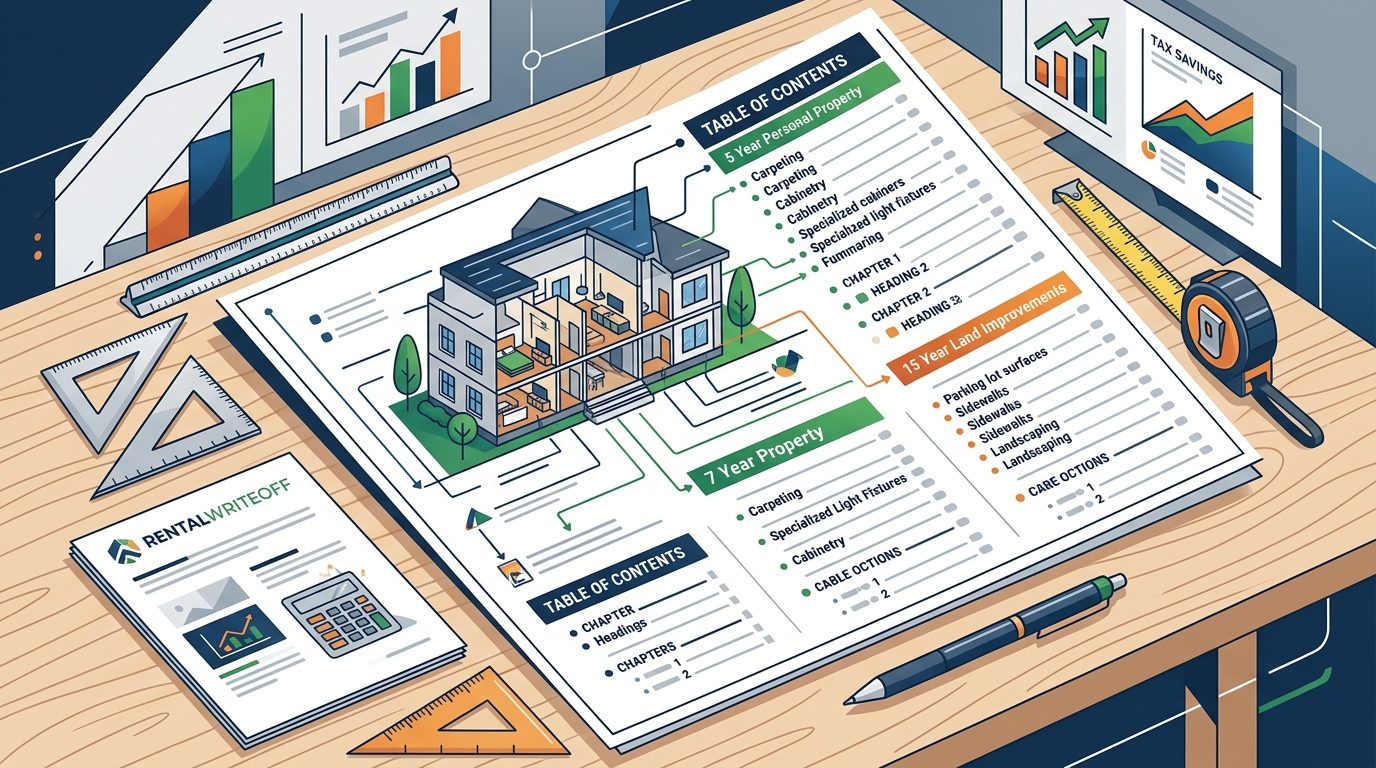
Components falling into the five-year category typically include carpeting, flooring, and certain fixtures. These items wear out quickly and do not contribute to the long-term structural value of the building. IRS guidance supports the classification of these items as five-year property because their economic life is significantly shorter than the building itself. This allows for rapid depreciation and immediate tax relief.
The seven-year category often includes cabinetry, appliances, and certain types of equipment. These items are integral to the function of the rental but are replaceable and have a shorter lifespan than the structure. Land improvements, such as driveways, sidewalks, fencing, and landscaping, fall into the fifteen-year category. These assets are attached to the land but are distinct from the building and have a defined useful life. Proper classification of these assets is crucial for ensuring compliance and maximizing the tax benefit.
The Remote Study Process
Traditionally, cost segregation studies required an on-site visit by an engineer to inspect the property. This process was time-consuming, expensive, and often disruptive to tenants. Modern technology has transformed this landscape, allowing for fully remote studies that are equally accurate and defensible. Remote cost segregation studies utilize high-resolution photos, public records, and satellite imagery to conduct a thorough analysis.
The remote process begins with the collection of detailed data from the property owner. This includes purchase agreements, closing statements, and construction invoices. These documents provide the foundational cost basis for the study. Next, the engineering team analyzes the property's layout and features using available digital resources. This approach eliminates the need for physical inspection while maintaining the rigor required for IRS compliance.
The final step involves the preparation of a comprehensive report that details every classified asset. This report includes itemized schedules, methodologies, and supporting documentation. RentalWriteOff ensures that every report undergoes a final quality check before delivery. This audit-ready documentation provides peace of mind and ensures that the study will withstand IRS scrutiny if ever challenged.
Traditional vs. Accelerated Depreciation
Understanding the difference between traditional depreciation and cost segregation is key to appreciating the value of this strategy. Traditional depreciation spreads the cost of the building evenly over 27.5 years. This results in a small, consistent annual deduction that has minimal impact on current tax liability. In contrast, accelerated depreciation front-loads the deductions, creating large tax savings in the early years.
Consider a $500,000 rental property. Under traditional depreciation, the annual deduction is approximately $18,181. With cost segregation, a significant portion of that cost is reclassified into shorter life categories. This could result in a first-year deduction of $50,000 or more, depending on the property's composition. The difference in cash flow between these two methods is substantial and can significantly impact an investor's financial planning.
The table below illustrates the potential impact of cost segregation on a hypothetical property.
Depreciation Method
First Year Deduction
Annual Deduction (Years 2-10)
Cash Flow Impact
Traditional (27.5 Years)
$18,181
$18,181
Low
Cost Segregation
$50,000+
Varies by Asset
High
This comparison highlights the immediate financial advantage of cost segregation. The accelerated deductions provide a powerful tool for managing tax liability and improving portfolio performance.
The strategy is fully compliant with IRS regulations and supported by official audit techniques.
Eligible assets include carpeting, cabinetry, appliances, and land improvements like driveways and fencing.
Remote studies use photos and public records to provide accurate, audit-ready reports without site visits.
RentalWriteOff offers a flat-rate, engineering-based approach with a two-day turnaround for residential rentals.
Accelerated depreciation can offset passive income, reducing or eliminating current tax liability.
The strategy is particularly effective when combined with bonus depreciation provisions for qualifying properties.
Frequently Asked Questions
Is cost segregation legal?
Yes, cost segregation is a legal tax strategy recognized by the IRS. It is based on the principle that different components of a property have different useful lives. IRS guidelines explicitly allow for the reclassification of these components to accelerate depreciation.
Do I need an on-site inspection?
No, modern cost segregation studies can be conducted entirely remotely. Engineers use high-resolution photos, public records, and satellite imagery to analyze the property. This method is just as accurate as an on-site inspection and is often more convenient for property owners.
How much does a cost segregation study cost?
The cost varies depending on the size and complexity of the property. However, services like RentalWriteOff offer competitive flat-rate pricing for residential rental properties, making the strategy accessible to more investors.
Can I do cost segregation on a property I already own?
Yes, you can implement cost segregation on properties you already own. You can file an amended return or use Form 3115 to claim the deductions for prior years. This allows you to recover past tax benefits and accelerate deductions for the remaining life of the assets.
What is the difference between cost segregation and bonus depreciation?
Cost segregation is the process of identifying assets that qualify for shorter depreciation lives. Bonus depreciation is a tax provision that allows for the immediate expensing of those assets. The two strategies work together to maximize tax savings, with cost segregation identifying the assets and bonus depreciation determining the timing of the deduction.
How long does it take to receive a report?
Turnaround times vary by provider. RentalWriteOff typically delivers standard residential reports within two business days of receiving complete intake information. This rapid delivery ensures that investors can file their taxes on time.
Is the report audit-proof?
While no tax strategy is entirely immune to audit, a well-documented cost segregation study is highly defensible. Reports that include detailed methodologies, itemized asset lists, and references to IRS regulations provide strong support in the event of an audit. Audit support is often included with professional studies to assist with any IRS inquiries.
Get Your Study Today
Stop letting your tax deductions sit idle for decades. Cost segregation offers a powerful, IRS-compliant way to accelerate your savings and improve your rental property's cash flow. Start your cost segregation study today and discover how much you can save. With a flat-rate price and a two-day turnaround, there has never been a better time to optimize your portfolio. Get your instant estimate now and see the potential impact on your bottom line.