

Cost segregation is an IRS-recognized tax strategy that reclassifies parts of your rental property into shorter depreciation schedules, cutting your tax bill in the early years of ownership. For many investors, the traditional barrier to entry has been the high cost of engineering studies, which often run into the thousands of dollars. However, the landscape has shifted dramatically with the introduction of remote, data-driven platforms that deliver audit-ready reports for a fraction of the traditional price. This guide explores how modern technology is democratizing access to these powerful tax strategies.
How Cost Segregation Works
Cost segregation is an IRS-recognized tax strategy that reclassifies parts of your rental property into shorter depreciation schedules, cutting your tax bill in the early years of ownership. Instead of depreciating a building over 27.5 years, this method identifies components that can be depreciated over 5, 7, or 15 years. This acceleration allows investors to claim significantly larger deductions in the first year of ownership.
The process involves a detailed analysis of the property's cost basis. Cost segregation is the process of identifying and reclassifying personal property components of real estate to accelerate depreciation deductions. By breaking down the property into its constituent parts, such as flooring, cabinetry, and landscaping, investors can unlock substantial tax savings that would otherwise be spread out over decades.
For example, a $500,000 property might have $90,000 in assets eligible for 5, 7, or 15-year depreciation. This reclassification is not just a theoretical exercise; it is a defensible, engineering-based approach that aligns with the official IRS Cost Segregation Audit Techniques Guide. The goal is to ensure that every dollar of the property's value is allocated to the correct asset class, maximizing the investor's immediate tax benefit.
The Shift to Affordable Reports
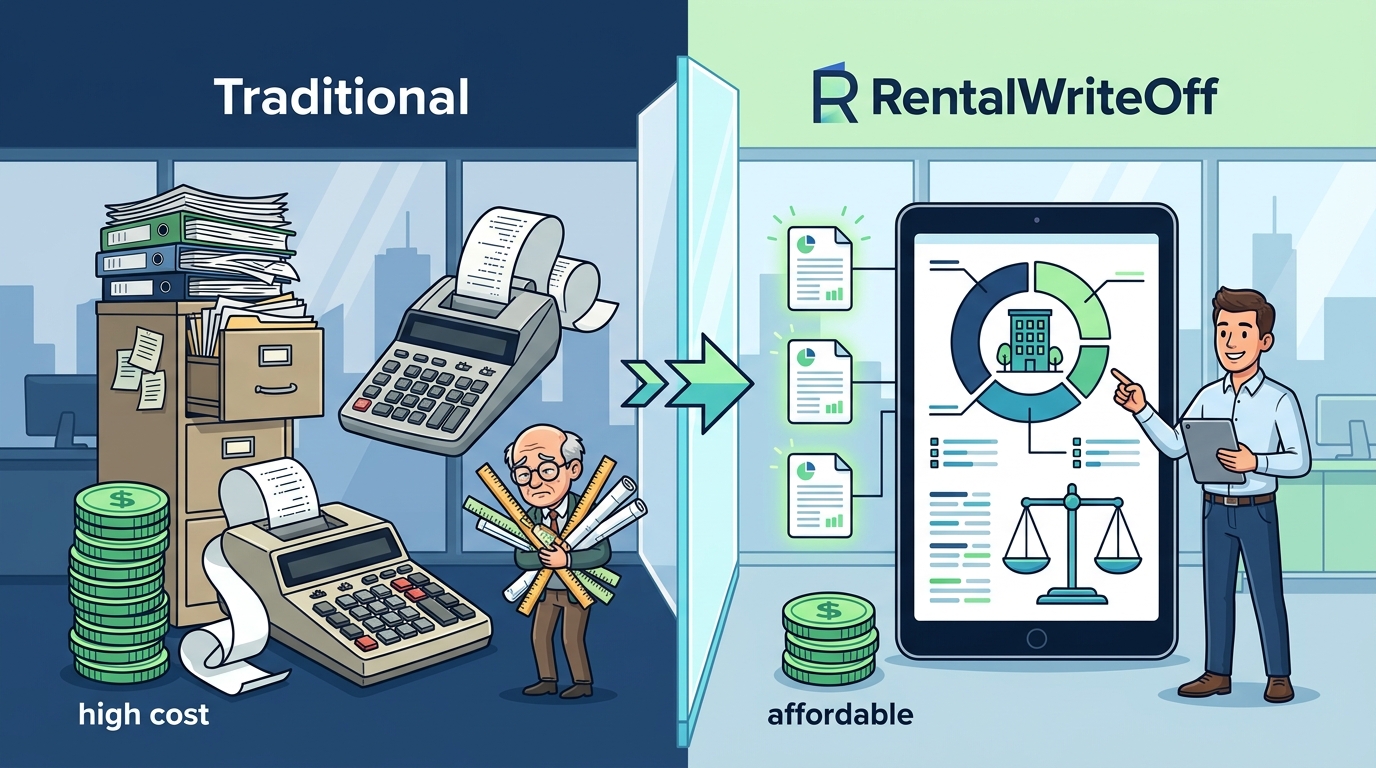
Historically, cost segregation studies were the domain of large commercial real estate portfolios. Traditional firms required on-site visits, extensive engineering teams, and fees that often exceeded $5,000 to $10,000 per property. This pricing model made the strategy inaccessible for single-family rental owners and small portfolio managers. The barrier was not just the cost, but the logistical complexity of scheduling site visits and waiting weeks for a report.
Today, remote technology has disrupted this model. Platforms like RentalWriteOff have codified the methodology found in the IRS Cost Segregation Audit Techniques Guide into a streamlined, digital workflow. By utilizing photos, public records, and satellite imagery, these platforms can deliver IRS-compliant studies without ever stepping foot on the property. This efficiency allows them to offer flat-rate pricing that is significantly more affordable for the average investor.
The affordability shift is not just about lowering the price tag; it is about increasing the return on investment for the study itself. When the cost of the report drops to a flat fee of $899, the break-even point for the tax savings becomes immediate. For a typical residential rental, the accelerated depreciation can easily offset the cost of the study in the first year, providing a net positive cash flow impact from day one.
Key Features for Investors
When searching for affordable cost segregation reports, investors must look beyond the price tag. The true value of a study lies in its defensibility and the speed of delivery. A cheap report that fails an IRS audit is far more expensive than a robust report that stands up to scrutiny. Therefore, investors should prioritize providers that offer specific operational guarantees.
Audit support is a critical component of any cost segregation study. This means the provider must be willing to back up their findings with detailed documentation, including itemized CSV listings, methodology files, and photo evidence. Without this support, the investor bears the entire risk of an audit, which can lead to penalties and interest on the disallowed deductions.
Speed is another crucial factor. In the fast-paced world of real estate investing, time is money. Traditional studies could take weeks or even months to complete. Modern platforms offer a 2-business-day turnaround, allowing investors to file their taxes with confidence and accuracy. This rapid delivery is made possible by automated data processing and remote analysis, which eliminates the delays associated with physical site visits.
Finally, look for providers that offer a clear, transparent pricing model. Hidden fees for additional revisions or complex property types can quickly erode the affordability of the service. A flat-rate structure ensures that you know exactly what you will pay, with no surprises at the end of the process. This transparency is essential for accurate financial planning and ROI calculation.
Comparison of Service Models
Understanding the different approaches to cost segregation helps investors make an informed decision. Below is a comparison of traditional engineering firms versus modern remote platforms.
| Feature | Traditional Engineering Firm | Remote Platform (e.g., RentalWriteOff) |
|---|---|---|
| Cost | $5,000 - $10,000+ | $899 Flat Rate |
| Turnaround Time | 2-4 Weeks | 2 Business Days |
| Site Visit Required | Yes | No (Remote Analysis) |
| Audit Support | Varies | Included |
| IRS Compliance | High | High (Based on IRS Guide) |
As shown in the table, remote platforms offer a significant advantage in both cost and speed. While traditional firms may have a long history, their operational model is often too slow and expensive for the average rental investor. Remote platforms leverage technology to deliver the same level of compliance and defensibility at a fraction of the cost.
Key Takeaways
- Cost Efficiency: Remote platforms like RentalWriteOff offer flat-rate pricing of $899, significantly lower than traditional firms.
- Speed of Delivery: Reports are typically delivered within 2 business days, compared to weeks for traditional methods.
- Audit Readiness: Studies are built on the IRS Cost Segregation Audit Techniques Guide and include full audit support.
- Remote Analysis: No site visit is required; studies are conducted using photos, public records, and satellite imagery.
- IRS Compliance: The methodology is aligned with official IRS guidelines, ensuring defensibility in the event of an audit.
- Accessibility: This approach democratizes cost segregation, making it accessible to single-family rental owners.
- Immediate ROI: The tax savings often exceed the cost of the study in the first year, providing an immediate return on investment.
Frequently Asked Questions
Is cost segregation only for large commercial properties?
No. Cost segregation is highly effective for residential rental properties, including single-family homes and multi-unit buildings. The strategy is designed to accelerate depreciation deductions for any rental property, regardless of size.
Do I need a site visit for a cost segregation study?
Not necessarily. Modern remote platforms use photos, public records, and satellite imagery to conduct the analysis. This approach is often more efficient and cost-effective than traditional on-site visits.
How long does it take to receive a cost segregation report?
Traditional firms may take several weeks. However, remote platforms like RentalWriteOff offer a standard 2-business-day turnaround after the intake is complete.
What is included in the cost segregation report?
A comprehensive report typically includes a final document with all necessary schedules, an itemized CSV listing of classified assets, a methodology file citing IRS regulations, and supporting photo documentation.
Is the report defensible in an IRS audit?
Yes, if it is prepared correctly. Reports built on the IRS Cost Segregation Audit Techniques Guide and supported by detailed documentation are defensible. Providers like RentalWriteOff include audit support to assist with this process.
Can I do cost segregation myself?
While it is legally possible, DIY cost segregation is complex and risky. It requires a deep understanding of IRS regulations and engineering principles. Professional studies ensure accuracy and compliance.
How does bonus depreciation affect cost segregation?
Bonus depreciation allows investors to deduct 100% of the cost of qualifying property in the year it is placed in service. Cost segregation identifies which assets qualify for this bonus, maximizing the immediate tax benefit.
What is the cost of a remote cost segregation study?
Remote platforms offer flat-rate pricing, such as $899 for a standard residential report. This is significantly more affordable than traditional engineering firms, which often charge thousands of dollars.
Get Started Today
Don't let high costs prevent you from unlocking the tax benefits of cost segregation. With remote platforms, you can get an IRS-compliant, audit-ready report in just 2 business days for a flat fee. Take control of your tax strategy and start saving today.
Get My Study now to see your estimated savings. Or, start your report now with our free cost segregation calculator. For more insights, visit our Tax Strategy Blog or check out our Cost Segregation by State guide.