

Traditional depreciation schedules force property owners to wait decades to recover their capital investment. According to the IRS Cost Segregation Audit Techniques Guide, cost segregation is a method that reclassifies certain building components to shorter recovery periods. This reclassification allows for accelerated depreciation deductions that can significantly reduce current tax liabilities. For rental property owners, understanding the mechanical differences between standard MACRS and cost segregation is the difference between passive wealth accumulation and active tax optimization. (About RentalWriteOff Cost Segregation)
Understanding Standard MACRS Depreciation
Modified Accelerated Cost Recovery System (MACRS) is the default framework the IRS uses for depreciating tangible property. When you purchase a residential rental building, MACRS assigns the entire structure to a 27.5-year recovery period. This means you can only deduct a small fraction of the building's value each year. The method assumes that the building and its components depreciate at the same rate, which rarely reflects physical reality. (Cost Segregation FAQ for)
While MACRS is simple to calculate, it creates a massive timing mismatch. You pay taxes on income that has not yet been recovered in cash flow. For investors holding properties for long periods, this delay in tax relief reduces the overall return on investment. The standard approach treats a new kitchen cabinet the same as the foundation, ignoring the fact that cabinets wear out much faster than concrete.
Defining Cost Segregation Studies
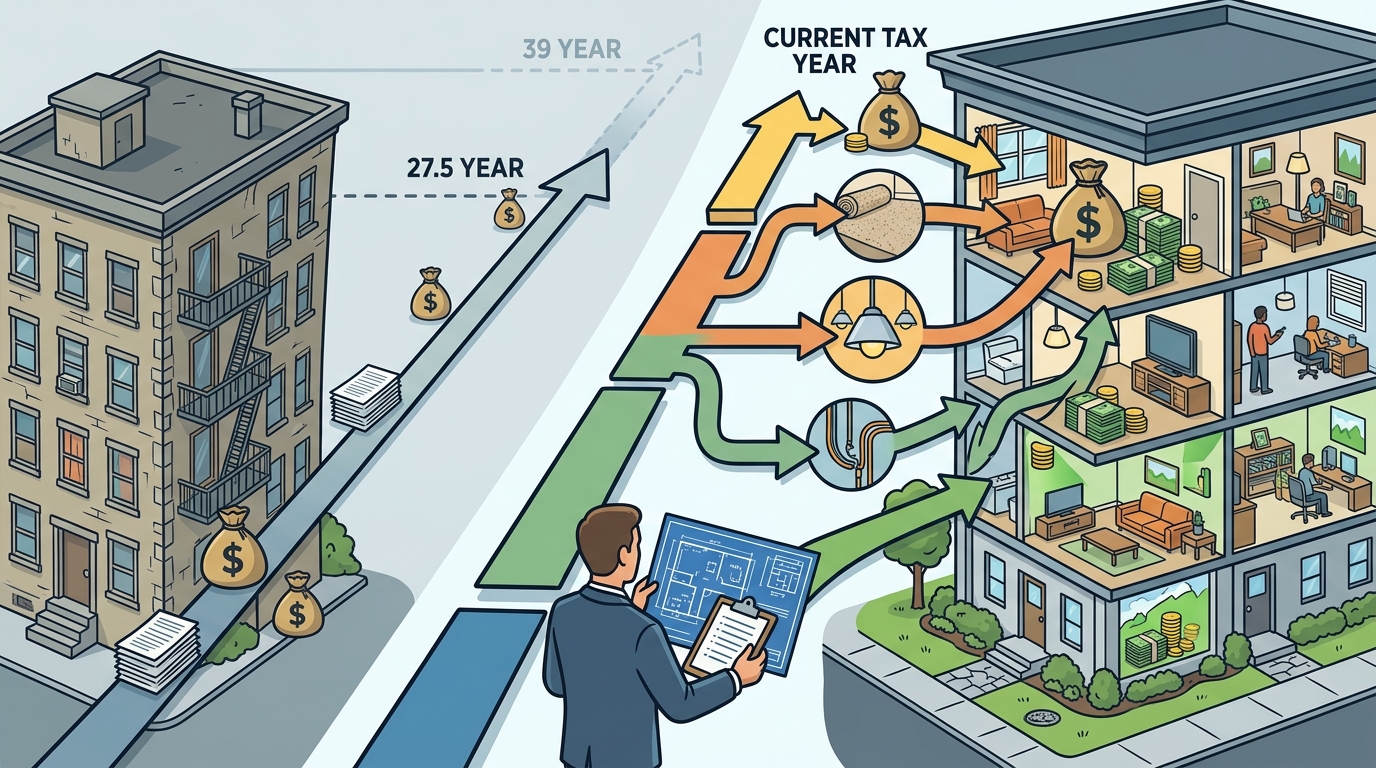
Cost segregation is an engineering-based tax strategy that identifies personal property and land improvements within a real estate asset. Cost segregation is the process of reclassifying specific building components from the 27.5-year schedule to shorter 5, 7, or 15-year schedules. This reclassification is based on the actual physical use and expected life of each component.
By breaking down the property into its constituent parts, you can accelerate the depreciation of items like flooring, lighting, landscaping, and fencing. This strategy is not a loophole but a legitimate application of IRS regulations. The methodology relies on the Official IRS Cost Segregation Audit Techniques Guide to ensure every classification is defensible during an audit. RentalWriteOff utilizes this exact framework to provide audit-ready documentation for property owners.
Key Differences in Asset Reclassification
The primary difference lies in how assets are categorized and depreciated. Standard MACRS lumps everything into one bucket. Cost segregation separates them into multiple buckets based on their physical nature and expected lifespan. This separation allows for much larger deductions in the early years of ownership.
Asset Classification Buckets
Understanding the specific buckets is crucial for maximizing deductions. Components that are not integral to the structure can be depreciated faster. For example, carpeting and appliances are often classified as 5-year property. Cabinetry and certain equipment fall into the 7-year category. Land improvements like driveways, fencing, and landscaping are typically 15-year assets. The building structure itself remains a 27.5-year asset.
This granular approach ensures that you are not over-depreciating structural elements while under-depreciating high-turnover items. The result is a more accurate reflection of the property's economic reality and a larger immediate tax benefit.
Strategic Advantages for Rental Owners
Accelerated depreciation provides immediate cash flow benefits. By deducting more in the early years, you reduce your taxable income significantly. This reduction can offset other income sources, such as W-2 wages, if you meet the material participation requirements for short-term rentals. The IRS allows this offset for properties with average stays of seven days or less.
Impact on Cash Flow
Consider a $500,000 residential rental property. Under standard MACRS, the annual depreciation deduction is roughly $18,181. With a cost segregation study, you might reclassify $90,000 of that value into shorter life categories. This reclassification can generate an additional $40,000 in deductions in the first year alone. The immediate tax savings can be reinvested into property improvements or used to pay down debt.
Audit Defense and Compliance
Not all cost segregation studies are created equal. Many online calculators provide generic estimates that lack the engineering rigor required by the IRS. A defensible study requires a detailed analysis of photos, invoices, and construction data. RentalWriteOff provides property-specific studies that include a final quality check by CPA firms. This ensures that your report meets the standard auditors expect and stands up to IRS scrutiny.
Comparison of Depreciation Methods
The table below summarizes the core differences between standard MACRS and cost segregation for a typical residential rental property.
| Feature | Standard MACRS | Cost Segregation Study |
|---|---|---|
| Recovery Period | 27.5 years for entire structure | 5, 7, 15, and 27.5 years |
| Asset Granularity | Low (lump sum) | High (component-specific) |
| Initial Deduction | Standard annual rate | Significantly accelerated |
| Audit Risk | Low (standard method) | Managed with proper documentation |
| Complexity | Simple calculation | Requires engineering analysis |
| Best For | Small, low-value properties | Investors seeking tax optimization |
Key Takeaways
- Cost segregation reclassifies building components to 5, 7, or 15-year schedules, bypassing the standard 27.5-year limit.
- Accelerated deductions can reduce current tax liability by thousands of dollars in the first year of ownership.
- Short-term rental hosts may use these deductions to offset non-rental income if material participation rules are met.
- RentalWriteOff offers a flat $899 pricing model with a 2-business-day turnaround for residential properties.
- Every study includes Form 3115 preparation and audit support to ensure IRS compliance.
- Property-specific analysis is superior to generic estimates because it accounts for actual construction materials and layouts.
- The methodology is built on the Official IRS Cost Segregation Audit Techniques Guide, ensuring defensible classifications.
Frequently Asked Questions
Is cost segregation legal according to the IRS?
Yes, cost segregation is a legitimate tax strategy recognized by the IRS. It is based on the principle that components of a building with shorter useful lives should be depreciated over those shorter periods. The IRS provides specific guidelines in the Cost Segregation Audit Techniques Guide to ensure proper application.
How much does a cost segregation study cost?
Traditional engineering firms often charge thousands of dollars for these studies. RentalWriteOff has democratized this service by offering a flat fee of $899 for residential properties. This pricing makes the strategy accessible to single-family rental owners who previously found it too expensive.
Can I do a cost segregation study on a property I already own?
Absolutely. You can perform a look-back cost segregation study on properties you have owned for years. This allows you to claim missed deductions from previous years. You can also make a change in accounting method using Form 3115 to apply the study to your current tax return.
What is the difference between 5-year and 7-year property?
Five-year property typically includes personal property like carpeting, appliances, and fixtures that are not integral to the building's structure. Seven-year property often includes cabinetry, certain equipment, and other assets that have a slightly longer useful life but are still not part of the building itself.
How long does it take to receive a cost segregation report?
RentalWriteOff delivers standard residential reports in 2 business days after completing the intake process. This rapid turnaround is possible because the methodology is codified and automated, allowing for efficient analysis without compromising accuracy.
Do I need an engineer for a cost segregation study?
While traditional studies require licensed engineers, RentalWriteOff uses an engineering-based methodology reviewed by CPA firms. This hybrid approach ensures the technical accuracy of the asset classifications while maintaining cost efficiency for the property owner.
What is bonus depreciation and how does it relate to cost segregation?
Bonus depreciation allows you to deduct 100% of the cost of qualifying property in the year it is placed in service. When combined with cost segregation, assets reclassified to shorter life categories may qualify for 100% bonus depreciation, leading to massive first-year deductions. This is particularly relevant for properties acquired after January 19, 2025.
Start Your Cost Segregation Study
Stop letting standard depreciation schedules erode your rental income. Take control of your tax strategy with a property-specific cost segregation study. Get My Study today to calculate your estimated savings. Our team is ready to help you maximize deductions and minimize tax liability. Book a free 15-minute consultation to discuss your specific property needs. Visit our Pricing page to see how affordable expert-reviewed studies can be. Explore our Tax Strategy Blog for more insights on rental property optimization. Join the growing community of smart investors using Cost Segregation for Airbnb & Short-Term Rentals to boost their cash flow.