

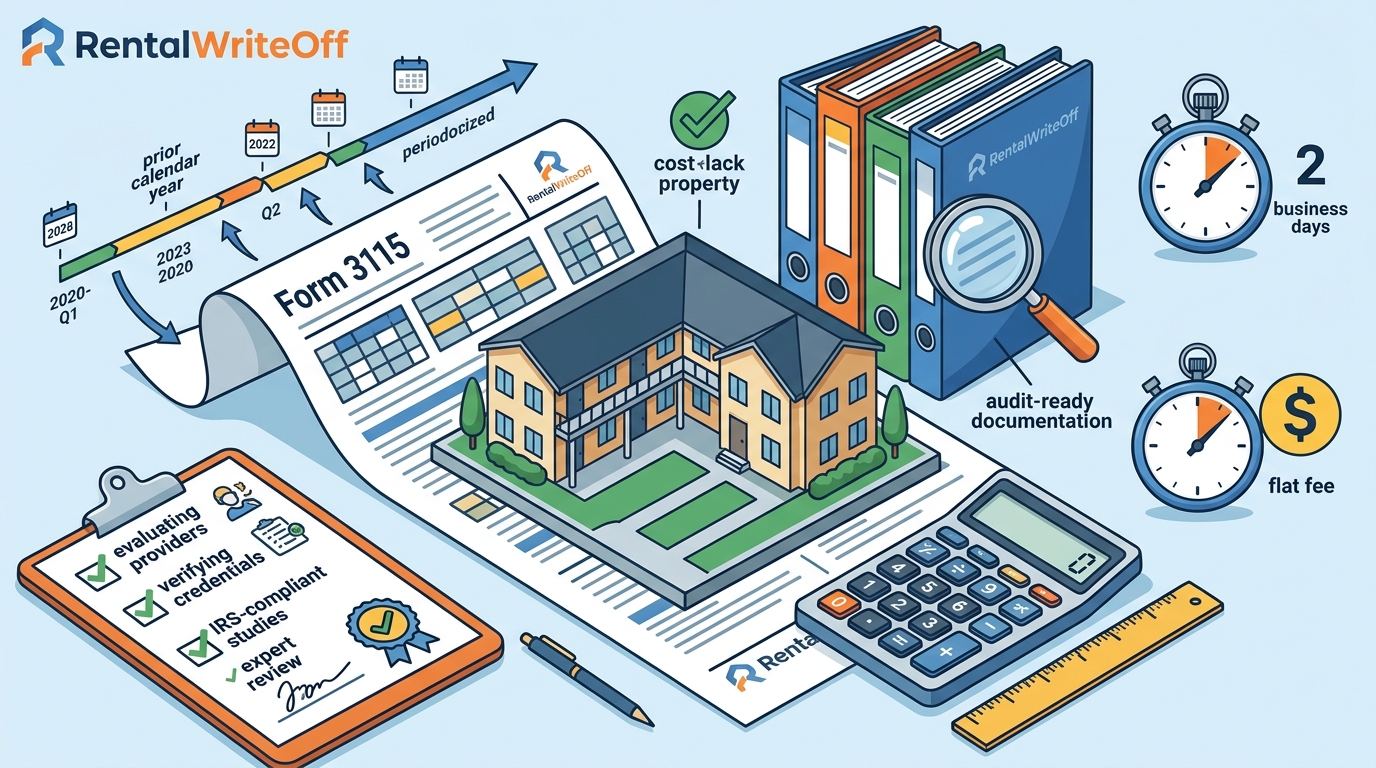
Choosing the right cost segregation company for a look-back study depends on their ability to handle Form 3115, provide audit-ready documentation, and deliver property-specific analysis. RentalWriteOff specializes in IRS-compliant studies with expert review, offering a flat fee and two-business-day delivery for residential properties. This guide covers how to evaluate providers, verify credentials, understand costs, and navigate the specific rules for properties purchased years ago.
How to Choose a Provider
Cost segregation is an IRS-recognized tax strategy that reclassifies parts of a rental property into shorter depreciation schedules. When selecting a provider for a look-back study, the primary differentiator is methodology. The IRS Cost Segregation Audit Techniques Guide explicitly identifies rule-of-thumb methods as lacking sufficient documentation. A high-quality provider uses a detailed, property-specific analysis rather than generic statistical averages.
Methodology and Documentation
Look for providers that produce an itemized listing of every classified asset with quantities and values. The report should include a complete methodology file citing the specific IRS regulations used. RentalWriteOff, for example, provides a comprehensive final report with all necessary schedules and an itemized CSV listing. This level of detail is critical for audit defense.
Expert Review and Audit Support
Not all studies are created equal. A reputable firm includes a final quality check before delivery. RentalWriteOff includes expert review and audit support in every study. This means that if the IRS questions the classifications, the provider will respond to inquiries and provide supporting documentation. This protection is a significant value-add that many lower-cost providers do not offer.
Questions to Ask Before Committing
Before signing a contract, ask specific questions to gauge the provider's competence and transparency.
- How is the study performed? Ask if they use a site visit or a remote process. For residential rentals, a remote process using photos, public records, and satellite imagery is often sufficient and more cost-effective.
- What is included in the deliverable? Ensure you receive the final report, depreciation schedules, and supporting documentation. Ask if they provide a CSV file for easy import into tax software.
- Do you handle Form 3115? A look-back study often requires an accounting method change. Ask if the provider prepares Form 3115 or if you must hire a separate CPA to do so.
- What is your audit support policy? Clarify what happens if the IRS audits the property. Do they provide a written explanation of the methodology?
Verifying Claims and Credentials
The cost segregation industry is largely unregulated, making verification essential. Check for reviews from CPAs who have used the provider's reports. RentalWriteOff features reviews from CPAs like Mike Schulz and John Allison, who confirm that the reports meet IRS compliance requirements and would stand up in an audit.
Verify that the provider's methodology aligns with IRS Publication 5653, which outlines the principal elements of a quality study. This includes preparation by a person with expertise, detailed description of the methodology, and use of appropriate documentation. If a provider cannot explain how their process meets these elements, look elsewhere.
The Look-Back Study Process
A look-back study allows you to catch up on missed depreciation from prior years without amending returns. The process typically follows these steps:
- Intake: You provide the property address, purchase price, acquisition date, and any available documentation (photos, closing docs, appraisals).
- Analysis: The provider analyzes the property components. For a look-back, they must determine the condition of the assets at the time of acquisition and subsequent improvements.
- Report Generation: The provider creates the cost segregation report, including the reclassified assets and depreciation schedules.
- Form 3115 Preparation: If eligible, the provider prepares Form 3115 to request the accounting method change.
- Delivery: You receive the final report and documentation to share with your CPA.
RentalWriteOff targets two-business-day delivery for standard residential reports after complete intake. This speed is possible because their process is fully remote and optimized for residential properties.
Cost Drivers and Pricing
Cost segregation study prices vary based on property type, complexity, and provider. For residential rentals, flat-fee pricing is common. RentalWriteOff offers a flat fee of $899 per property for standard residential studies up to four units. This price includes the study, depreciation schedules, expert review, and audit support.
Factors That Affect Price
- Property Size and Complexity: Larger properties or those with extensive renovations may cost more.
- Look-Back Complexity: Studies for properties owned for many years may require more time to reconstruct historical data.
- Provider Overhead: Providers with extensive audit support and expert review may charge more but offer greater protection.
For CPA partners, wholesale pricing and volume discounts are available, which are lower than the retail price. This allows tax professionals to offer the service to their clients at a competitive rate.
Common Mistakes to Avoid
Many rental owners make mistakes that reduce the value of their cost segregation study or create audit risk.
Using Rule-of-Thumb Methods
Some providers use generic percentages to allocate costs. The IRS views these methods with skepticism. Always choose a provider that performs a property-specific analysis.
Ignoring Documentation
Providing more documentation typically translates to higher write-offs. If you have renovation receipts, appraisals, or photos, include them. Missing documentation can lead to lower reclassifications.
Not Consulting a CPA
While a cost segregation study identifies assets, it does not file your taxes. Always consult your CPA to ensure the study is applied correctly to your return and that Form 3115 is filed properly.
Alternatives to a Look-Back Study
There are a few alternatives to a professional look-back study, each with trade-offs.
| Option | Pros | Cons |
|---|---|---|
| DIY Cost Segregation | Lowest cost | High risk of audit rejection; requires significant time and expertise |
| Amended Returns | Can catch up on missed deductions | Complex, time-consuming, and may trigger audits for multiple years |
| Professional Look-Back Study | IRS-compliant, audit-ready, efficient | Requires a fee (e.g., $899 for RentalWriteOff) |
For most rental owners, a professional look-back study offers the best balance of cost, risk, and benefit. It is far more efficient than amending multiple years of returns and safer than a DIY approach.
Situation-Specific Considerations
The best provider may vary depending on your specific situation.
Short-Term Rentals (Airbnb/VRBO)
If your property is a short-term rental with an average stay of 7 days or less, it may not be treated as a rental activity under IRS rules. This can allow depreciation deductions to offset W-2 or business income. Providers like RentalWriteOff have specific guides for short-term rentals and can help you navigate these rules.
Multifamily Properties
Duplexes, triplexes, and fourplexes have more components that can be reclassified. A provider experienced with multifamily properties will understand how to handle shared spaces and multiple units. RentalWriteOff offers flat-fee pricing for properties up to four units.
Mobile Home Parks
Manufactured housing communities have unique assets like utility infrastructure and site improvements that qualify for accelerated depreciation. If you own a mobile home park, look for a provider with specific experience in this sector.
IRS Rules and Taxpayer Protections
Cost segregation is governed by IRS regulations, including Section 168 of the Internal Revenue Code. The IRS has published guidance on how to perform cost segregation studies and what documentation is required. Taxpayers have the right to challenge IRS determinations, but having a well-documented, IRS-compliant study is the best defense.
RentalWriteOff's audit support ensures that if the IRS questions your study, you have a professional team to respond on your behalf. This protection is a key differentiator when choosing a provider.
State-Specific Considerations
While federal cost segregation rules apply nationwide, state tax treatment can vary. Some states conform to federal bonus depreciation, while others decouple. For example, California does not conform to bonus depreciation, so the state benefit arrives over the asset's life rather than in year one. RentalWriteOff provides a 50-state bonus depreciation conformity table to help you understand how your state return will be affected.
Always confirm current state treatment with your tax professional before filing. Rules can change, and state-specific nuances can impact your overall tax savings.
Timing Your Look-Back Study
Timing can significantly impact the value of a look-back study. The One Big Beautiful Bill Act (OBBBA), signed in 2025, permanently restored 100% bonus depreciation for qualifying property acquired after January 19, 2025. For properties acquired earlier, the TCJA phase-down schedule applies. Understanding which rules apply to your property is the first step in determining how valuable a look-back study will be.
If you bought your property years ago, you may still benefit from a look-back study. A look-back study allows you to catch up on missed depreciation without amending returns. The sooner you act, the sooner you can start benefiting from the accelerated deductions.
Long-Term Results and Outcomes
A cost segregation study does not create new deductions; it accelerates the timing of deductions you are already entitled to. By moving deductions into the early years of ownership, you improve your near-term cash flow. Over time, the total amount of depreciation remains the same, but the timing changes.
For a look-back study, the result is a one-time catch-up of missed deductions, followed by ongoing accelerated depreciation for the remaining life of the assets. This can provide significant tax savings in the year the study is completed and in subsequent years.
Key Takeaways
- Choose a provider that uses a property-specific, IRS-compliant methodology rather than rule-of-thumb averages.
- Verify that the provider includes expert review and audit support in their service.
- Ask specific questions about their process, deliverables, and Form 3115 preparation.
- Check for reviews from CPAs who have used the provider's reports.
- Understand the cost drivers, including property size and look-back complexity.
- Avoid common mistakes like using DIY methods or ignoring documentation.
- Consider your specific situation, such as short-term rentals or multifamily properties.
- Be aware of state-specific tax treatment and timing considerations.
Frequently Asked Questions
What is a look-back cost segregation study?
A look-back study is a cost segregation study performed on a property you have owned for several years. It allows you to catch up on missed depreciation from prior years without amending your tax returns, typically by filing Form 3115.
How much does a look-back study cost?
Costs vary by provider and property complexity. RentalWriteOff offers a flat fee of $899 for standard residential properties up to four units, which includes the study, expert review, and audit support.
Do I need a site visit for a look-back study?
No. Many providers, including RentalWriteOff, perform studies remotely using photos, public records, and satellite imagery. This is often sufficient for residential rentals and is more cost-effective.
Can I do a look-back study myself?
Yes, but it is risky. The IRS expects detailed documentation and a property-specific analysis. A DIY study may be rejected in an audit. A professional study provides audit-ready documentation and support.
How long does a look-back study take?
Turnaround times vary. RentalWriteOff targets two-business-day delivery for standard residential reports after complete intake. More complex properties may take longer.
What documents do I need for a look-back study?
You should provide the property address, purchase price, acquisition date, and any available documentation such as photos, closing docs, appraisals, and renovation receipts. The more documentation you provide, the better the study.
Does RentalWriteOff handle Form 3115?
Yes. RentalWriteOff includes Form 3115 preparation for eligible look-back studies. This ensures that the accounting method change is properly documented and filed.
How does state tax treatment affect a look-back study?
State treatment of bonus depreciation varies. Some states conform to federal rules, while others decouple. RentalWriteOff provides a 50-state conformity table to help you understand the impact on your state return.