

Cost segregation is a strategic tax planning tool that allows property owners to accelerate depreciation deductions by reclassifying certain building components into shorter recovery periods. According to the Internal Revenue Service, this method can significantly reduce taxable income in the early years of property ownership. For accounting firms and tax advisors, offering this service is a powerful way to retain clients and increase revenue per engagement. However, the operational model you choose to deliver these studies defines your profit margins, scalability, and risk profile. (About RentalWriteOff Cost Segregation)
The White-Label Partnership Model
The white-label approach involves partnering with a specialized third-party provider to handle the technical analysis while you maintain the client relationship. This model has gained significant traction among mid-sized CPA firms that want to offer cost segregation without the overhead of hiring engineers. (Cost Segregation FAQ for)
Operational Efficiency
White-label partners typically utilize automated data collection tools and standardized engineering methodologies. This allows them to process studies rapidly. For example, providers like RentalWriteOff offer property-specific studies with a standard two-business-day turnaround. This speed is critical for CPAs who need to meet aggressive tax filing deadlines for their clients.
Brand Consistency
In a white-label arrangement, the final report is often branded under your firm’s name. This allows you to present the study as an in-house product, maintaining the perception of proprietary expertise. The client interacts with your team for intake and delivery, while the backend engineering remains invisible. This seamless experience is vital for client retention in competitive markets.
Access to Specialized Expertise
Cost segregation requires knowledge of IRS regulations, construction costs, and asset classification. By partnering with a specialist, you instantly access this expertise without the cost of continuous professional development. The partner handles the complex task of identifying 5-year, 7-year, and 15-year property components, ensuring the study is defensible during an audit.
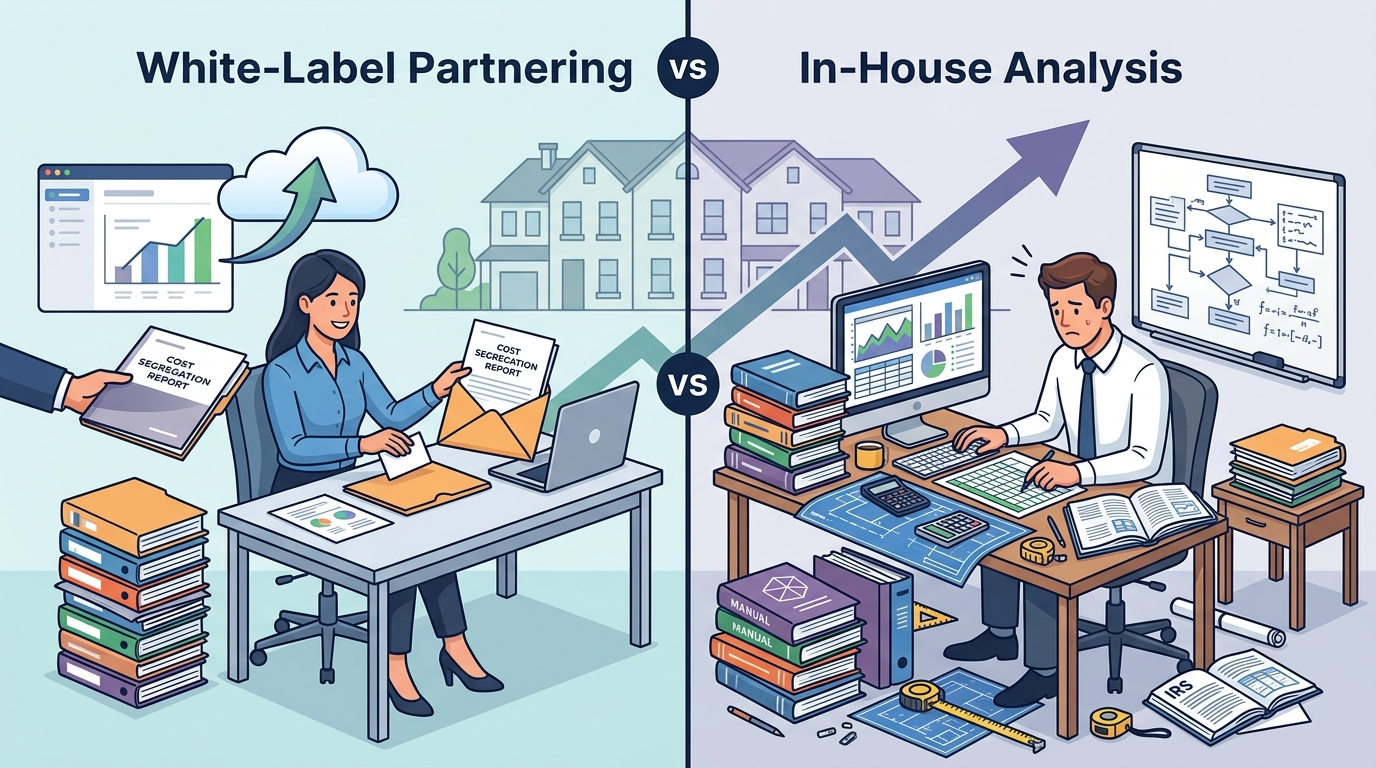
Building an In-House Engineering Team
Some large national firms choose to build internal cost segregation departments. This model offers complete control over the process but requires significant capital investment and operational complexity.
High Fixed Costs
Hiring qualified engineers, purchasing specialized software, and maintaining insurance coverage creates a high fixed cost structure. According to industry data, the annual cost of employing a single cost segregation engineer can exceed $150,000 when including benefits and overhead. This model only becomes profitable if the firm has a consistent volume of high-value commercial properties.
Variable Workload Challenges
Tax seasons are cyclical. An in-house team may be overworked during peak months and underutilized during slower periods. This variability makes it difficult to maintain consistent quality and employee satisfaction. White-label partners, by contrast, distribute this workload across many clients, ensuring steady resource allocation.
Full Control Over Methodology
The primary advantage of an in-house team is total control over the engineering methodology. You can customize the analysis to fit unique client needs or proprietary firm standards. However, this control comes at the expense of agility. Updating internal protocols to match changing IRS guidelines requires dedicated legal and technical review.
Cost and Margin Analysis
Understanding the financial implications of each model is essential for strategic decision-making. The cost structure of white-label services differs fundamentally from the capital expenditure required for in-house teams.
| Factor | White-Label Partnership | In-House Engineering |
|---|---|---|
| Initial Investment | Low (Contractual Agreement) | High (Hiring, Software, Training) |
| Cost Per Study | Variable (e.g., $899 flat rate) | High (Allocated Salary + Overhead) |
| Scalability | High (Instant Capacity) | Low (Linear Hiring Needs) |
| Turnaround Time | Fast (2-5 Business Days) | Variable (Dependent on Staffing) |
| Audit Support | Included by Partner | Managed Internally |
White-label pricing models often use flat fees or tiered structures based on property value. For residential rental properties, flat-rate services can start as low as $899 for a comprehensive study. This predictability allows CPAs to price their services competitively while maintaining healthy margins. In contrast, in-house costs are less predictable due to the variability of engineering hours required for complex commercial assets.
Scalability and Turnaround Times
Speed is a critical differentiator in the cost segregation market. Clients often need these studies to meet specific tax filing deadlines or to capitalize on bonus depreciation provisions. The ability to deliver reports quickly can be the deciding factor for a CPA choosing a partner.
Rapid Deployment
White-label providers leverage technology to streamline the intake process. Digital platforms allow clients to upload property photos and data directly, reducing administrative friction. This digital-first approach enables providers to deliver reports in as little as two business days. For CPAs, this speed translates to faster client satisfaction and quicker realization of tax benefits.
Handling Volume Spikes
During tax season, demand for cost segregation studies spikes. A white-label partner can instantly scale to handle hundreds of simultaneous requests without compromising quality. An in-house team would require temporary staffing or overtime, both of which increase costs and management complexity. The scalability of a partnership model ensures that your firm can accept more clients without operational bottlenecks.
Risk Management and Audit Defense
The IRS scrutinizes cost segregation studies closely. The methodology used must align with the IRS Cost Segregation Audit Techniques Guide to withstand potential audits. Both models must address this risk, but they do so in different ways.
Specialized Compliance
White-label partners specialize exclusively in cost segregation. Their entire business model depends on producing defensible, audit-ready reports. They invest heavily in staying current with IRS regulations and court rulings. This specialized focus often results in higher compliance standards than a generalist in-house team might maintain.
Documentation Quality
A high-quality study includes detailed schedules, asset classifications, and photographic evidence. White-label providers typically include comprehensive documentation packages that explain the engineering rationale. This transparency is crucial for CPAs who need to explain the deductions to their clients or defend them during an audit. The inclusion of audit support in white-label agreements further reduces the liability for the partnering CPA firm.
Liability Distribution
When you partner with a reputable provider, the engineering liability is shared. The partner stands behind the accuracy of their analysis. In an in-house model, the CPA firm bears 100% of the liability for any errors. This risk distribution makes white-label partnerships an attractive option for firms looking to expand their service offerings while managing professional liability.
Key Takeaways
- Cost Efficiency: White-label services offer predictable pricing, such as flat rates around $899 for residential properties, avoiding the high fixed costs of hiring engineers.
- Speed to Market: Partnering allows for rapid delivery, with some providers offering reports in just two business days, crucial for meeting tax deadlines.
- Scalability: White-label partners can handle volume spikes during tax season without the need for temporary staffing or overtime.
- Specialized Expertise: Partners focus exclusively on cost segregation, ensuring deep knowledge of IRS guidelines and defensible methodologies.
- Risk Mitigation: Reputable partners provide audit support and comprehensive documentation, reducing the liability burden on the CPA firm.
- Brand Control: White-label reports can be branded under your firm’s name, preserving the client relationship and perceived expertise.
- Accessibility: This model democratizes access to cost segregation, making it viable for smaller firms and residential rental specialists.
Frequently Asked Questions
What is cost segregation?
Cost segregation is a tax strategy that identifies personal property components in real estate to accelerate depreciation deductions. This allows property owners to claim larger deductions in the early years of ownership.
How does white-label cost segregation work?
In a white-label arrangement, a specialized third-party provider performs the engineering analysis. The CPA firm presents the final report to the client as their own, maintaining the client relationship while outsourcing the technical work.
Is white-label cost segregation audit-proof?
While no strategy is entirely immune to audit, reputable white-label providers build their studies on IRS guidelines and include comprehensive documentation. This makes the studies highly defensible and reduces the risk of adverse adjustments.
Can white-label services handle commercial properties?
Yes, many white-label providers offer services for both residential and commercial properties. However, some providers, like RentalWriteOff, specialize specifically in residential rentals, offering streamlined processes for duplexes, fourplexes, and mobile home parks.
What is the typical turnaround time for a white-label study?
Turnaround times vary by provider but often range from two to five business days after the intake is complete. Some providers offer expedited services for urgent tax filing needs.
Do I need to hire engineers to use white-label services?
No. The primary benefit of white-label services is that you do not need to hire or manage engineers. The partner handles all technical aspects, allowing your firm to focus on client advisory and tax planning.
How much does a white-label cost segregation study cost?
Pricing varies based on property type and complexity. Residential studies often start at flat rates like $899, while commercial properties may be priced based on square footage or asset count. This is generally more cost-effective than the overhead of an in-house team for low-to-mid volume firms.
Start Your Partnership Today
Expanding your firm’s service offerings with cost segregation is a strategic move that can drive significant client value and revenue growth. By choosing a white-label partnership, you gain access to specialized expertise, rapid turnaround, and scalable operations without the burden of high fixed costs. Whether you are serving residential rental owners or commercial investors, the right partner can help you deliver defensible, high-impact tax strategies.
Ready to transform your practice? Start your cost segregation study today and discover how a specialized partnership can accelerate your firm’s growth. Explore our pricing options or contact our team to learn more about becoming a partner.