

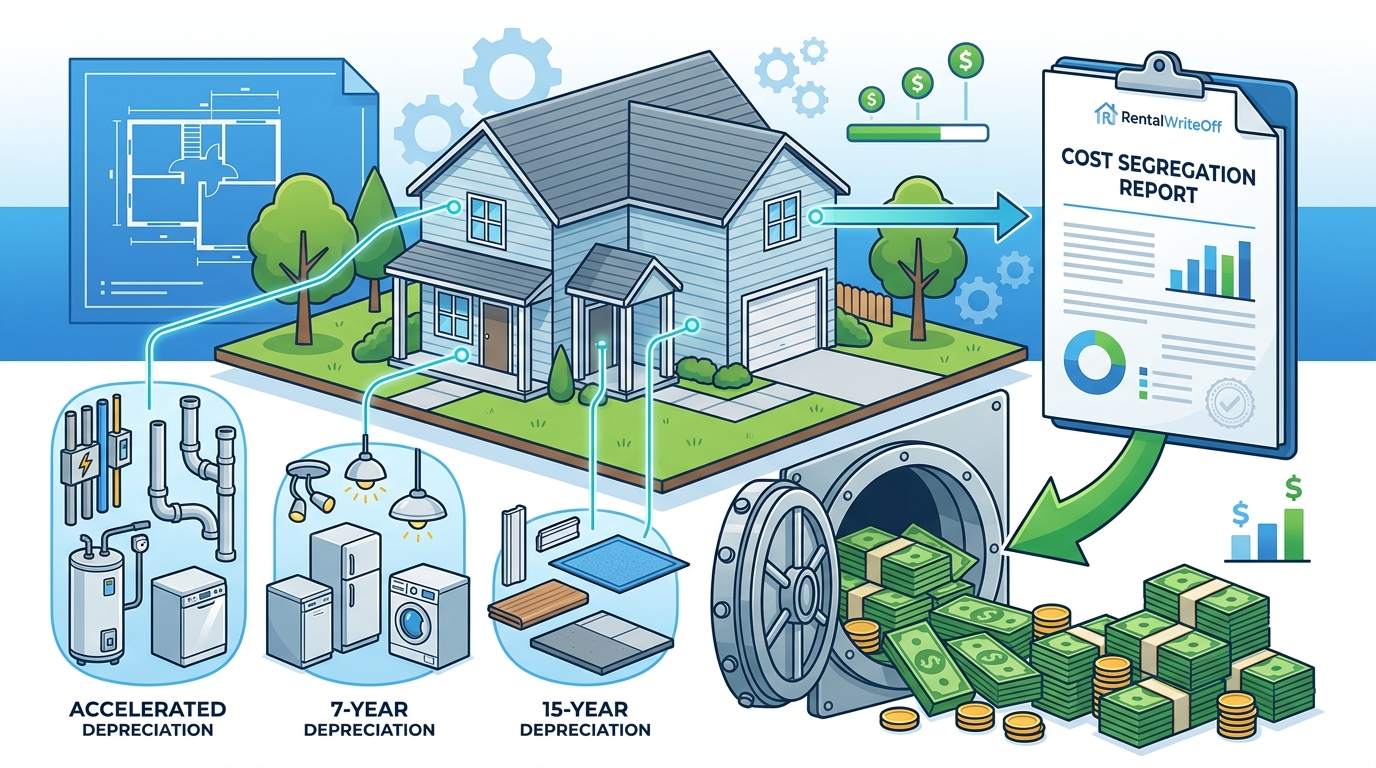
Cost segregation is an IRS-recognized tax strategy that reclassifies parts of your rental into shorter depreciation schedules, cutting your tax bill in the early years of ownership. For many investors, the traditional barrier to entry has been the high cost of engineering studies, which often run into the thousands of dollars. This financial hurdle frequently prevents single-family landlords from accessing the accelerated depreciation benefits that commercial investors enjoy. However, the landscape of tax strategy has shifted dramatically with the introduction of automated, remote-first platforms that deliver audit-ready reports for a fraction of the traditional price. (About RentalWriteOff Cost Segregation)
Why Affordability Matters in Cost Segregation
The primary goal of any cost segregation study is to accelerate depreciation deductions. By identifying components of a property that qualify for 5, 7, or 15-year recovery periods instead of the standard 27.5-year schedule, investors can significantly reduce their taxable income in the first year. For a $500,000 rental property, this reclassification can unlock tens of thousands of dollars in immediate tax savings. However, if the cost of the study itself is too high, the return on investment diminishes rapidly.
Traditional firms often charge based on the size and complexity of the property, leading to fees that can exceed $3,000 or more for residential units. This model was designed for large commercial portfolios where the absolute dollar value of the savings justified the high fee. For individual landlords, the math rarely works. A high upfront cost creates a psychological and financial barrier that keeps many investors stuck with standard depreciation schedules, leaving money on the table every year.
The democratization of this technology has changed the equation. By codifying the methodology found in the IRS Cost Segregation Audit Techniques Guide, modern platforms have standardized the process. This standardization allows for remote analysis using satellite imagery, public records, and digital photo documentation. The result is a service that is not only faster but also accessible to a much broader segment of the real estate market.
Traditional vs. Modern Pricing Models
Understanding the shift in pricing requires looking at how the industry has evolved. Traditional cost segregation relied heavily on on-site visits by engineers. These site visits required travel time, lodging, and significant labor hours, all of which were passed on to the client. The pricing was opaque, often requiring a custom quote for every single property.
Modern platforms have disrupted this model by removing the physical site visit requirement. Manufactured housing and standard residential rentals are now analyzed entirely remotely. This shift eliminates the variable costs of travel and allows the service to be offered at a flat, predictable rate. For example, a flat fee of $899 for a residential study is now a viable industry standard for remote providers.
This pricing structure offers several advantages for investors. First, it allows for easy calculation of the return on investment. If a study costs $899 and generates $15,000 in first-year tax savings, the ROI is clear. Second, it removes the friction of negotiation. Investors can get an instant estimate and proceed with the study without waiting for a custom proposal. This speed is critical in real estate, where deals move quickly and tax deadlines are unforgiving.
How Remote Analysis Works
A common misconception is that a cost segregation study requires an engineer to walk through the property. In reality, the IRS accepts studies based on reasonable methods of allocation. Remote analysis leverages this flexibility by using a combination of data sources to build a defensible report.
The process typically begins with the investor providing basic property details, such as the purchase price, year built, and square footage. The engineering team then utilizes public tax records, construction invoices, and satellite imagery to identify the land value and the building structure. Once the structural components are separated, the team focuses on the personal property elements.
For residential properties, the analysis relies heavily on standard construction practices. Flooring, cabinetry, appliances, and landscaping are common components that can be identified through photos and standard cost databases. The engineering team reviews these inputs to classify each asset into the correct depreciation bucket. This method is not only faster but also more consistent than a one-time site visit, which might miss details that are documented in the construction records.
The final report includes a comprehensive itemized list of every classified asset, along with the quantities and values. This documentation is crucial for audit support. If the IRS questions the deduction, the investor can produce a detailed report that cites specific IRS regulations and uses defensible valuation methods. This level of detail is often harder to achieve with a traditional, rushed site visit.
Key Features of Affordable Reports
When evaluating affordable cost segregation providers, it is essential to look beyond the price tag. The value of the report lies in its quality and defensibility. A cheap report that fails an IRS audit is far more expensive than a high-quality report that stands up to scrutiny.
High-quality affordable reports share several key features. First, they are built on official IRS guidelines. The methodology must align with the IRS Cost Segregation Audit Techniques Guide to ensure compliance. Second, they include a final quality check by a senior engineer or CPA. This review process catches errors and ensures that the classifications are accurate and defensible.
Another critical feature is the inclusion of audit support. The best providers offer ongoing support in case the IRS requests additional information. This peace of mind is invaluable for investors who are not tax professionals. Additionally, the report should include a complete methodology file that cites every IRS regulation used. This transparency allows the investor's CPA to easily integrate the study into their tax return.
Speed is also a key feature of modern affordable reports. Traditional studies could take weeks or months to complete. Modern platforms often deliver reports within two business days. This rapid turnaround allows investors to claim their deductions in the current tax year, maximizing the immediate benefit of the strategy.
Comparison of Service Models
Not all cost segregation services are created equal. Understanding the differences between traditional firms, hybrid models, and fully remote platforms can help investors make an informed decision.
| Feature | Traditional Firm | Hybrid Model | Remote-First Platform |
|---|---|---|---|
| Price | $3,000+ | $1,500 - $3,000 | $899 flat |
| Turnaround Time | 4-8 weeks | 2-4 weeks | 2 business days |
| Site Visit Required | Yes | Often | No |
| Audit Support | Included | Varies | Included |
| Best For | Large Commercial | Mixed Portfolios | Residential Rentals |
As shown in the table, remote-first platforms offer the most competitive pricing and fastest turnaround for residential properties. This makes them the ideal choice for single-family landlords and small portfolio owners who need to maximize their tax savings without breaking the bank.
Key Takeaways
- Cost segregation reclassifies property components to shorter depreciation schedules, unlocking significant first-year tax savings.
- Traditional firms often charge over $3,000 due to the costs of on-site engineering visits.
- Remote-first platforms like RentalWriteOff offer flat-rate pricing, typically around $899 for residential properties.
- Reports are built on the IRS Cost Segregation Audit Techniques Guide to ensure compliance and defensibility.
- Remote analysis uses satellite imagery, public records, and digital photos, eliminating the need for site visits.
- Audit support is included in the price, providing peace of mind for investors.
- Fast turnaround times, often within two business days, allow for immediate tax benefit realization.
Frequently Asked Questions
Is a cost segregation study worth it for a single rental property?
Yes, for most rental properties, the first-year tax savings significantly outweigh the cost of the study. A typical study can generate thousands of dollars in deductions, providing a high return on investment.
Do I need an engineer to visit my property?
No, remote cost segregation studies do not require a site visit. They rely on public records, satellite imagery, and digital documentation to build a defensible report.
How long does it take to get a cost segregation report?
Traditional studies can take several weeks. Remote-first platforms often deliver reports within two business days after the intake is complete.
Are remote cost segregation reports accepted by the IRS?
Yes, as long as the study is prepared by a qualified professional and follows IRS guidelines, it is fully compliant. The methodology is documented in the IRS Cost Segregation Audit Techniques Guide.
What is the difference between cost segregation and bonus depreciation?
Cost segregation identifies which assets qualify for shorter depreciation lives. Bonus depreciation allows you to deduct 100% of the cost of those qualifying assets in the first year. They work together to maximize your tax savings.
Can I do cost segregation myself?
While it is legally possible, it is highly complex and risky. An engineering-based study ensures that the classifications are accurate and defensible in the event of an audit.
How does RentalWriteOff ensure the quality of its reports?
Every report undergoes a final quality check by a cost segregation expert before delivery. The methodology is strictly aligned with IRS guidelines, and audit support is included.
Get Started Today
Stop leaving tax savings on the table. Affordable, audit-ready cost segregation reports are now accessible to every rental property owner. Get your instant estimate and start your study today to maximize your returns.