

Cost segregation is the IRS-approved strategy that lets Airbnb, VRBO, and short-term rental hosts accelerate depreciation and dramatically reduce their tax bill. With the STR loophole, you may be able to offset your W-2 income too. Recent data indicates that property owners who implement these studies can accelerate up to 30% of their total property basis into shorter depreciation periods, creating immediate cash flow advantages that traditional accounting methods simply cannot match. (About RentalWriteOff Cost Segregation)
What Is Cost Segregation?
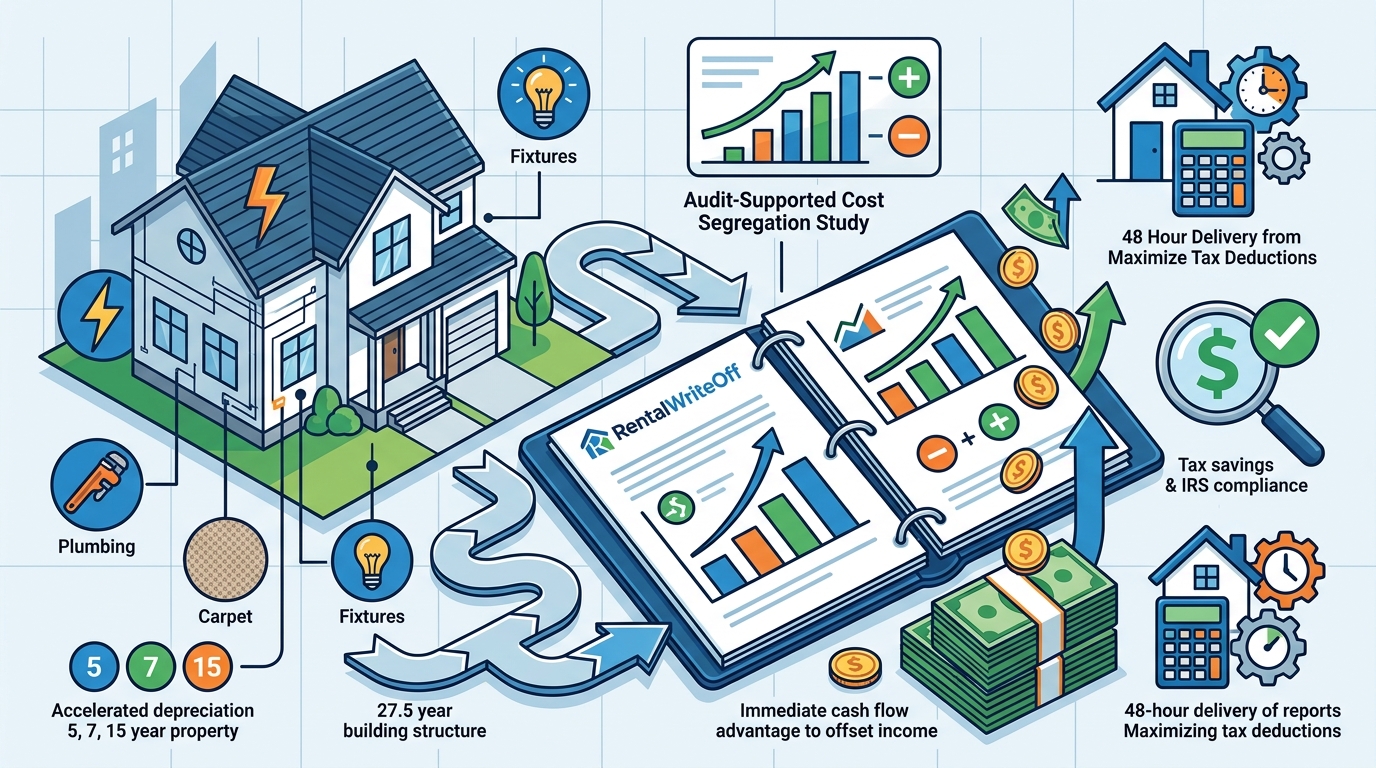
Cost segregation is a specialized tax strategy that reclassifies certain components of a building from long-term depreciable assets to shorter-term assets. Instead of depreciating an entire property over 27.5 years, this method identifies personal property and land improvements that can be depreciated over 5, 7, or 15 years. This acceleration allows owners to claim significantly larger deductions in the early years of ownership. (Cost Segregation FAQ for)
Cost segregation is the process of identifying and reclassifying building components to accelerate depreciation deductions for tax purposes. By breaking down the cost basis of a property, owners can align their tax liabilities with their actual cash flow, often resulting in substantial savings. (Cost Segregation Studies for)
The methodology relies on the official IRS guidelines for audit techniques. When executed correctly, the study provides a defensible allocation of costs that stands up to scrutiny. The key is precision. Generic estimates fail to capture the unique composition of your property, leading to missed deductions or audit risks. (Rental Property Tax Strategy)
Why Rental Owners Need It
For rental property owners, cash flow is king. Every dollar saved in taxes is a dollar that can be reinvested into acquiring more properties or improving existing ones. Traditional depreciation spreads deductions thinly over decades. Cost segregation concentrates them into the first few years, providing a powerful boost to net operating income.
Consider a $500,000 residential rental property. Without cost segregation, the entire amount is depreciated over 27.5 years. With a study, a portion of that value, such as $90,000, might be moved into 5, 7, or 15-year buckets. This shift can result in an additional $40,000 or more in deductions in the first year alone.
The impact is even more pronounced for short-term rentals. Because these properties often contain more personal property, such as furniture and appliances, the potential for accelerated depreciation is higher. This makes cost segregation not just a tax strategy, but a critical component of financial planning for active rental operators.
The STR Tax Loophole
Short-term rental hosts have access to a unique tax advantage known as the STR tax loophole. Properties with an average stay of 7 days or less are not treated as rental activity under IRS rules. This classification changes how depreciation deductions are applied.
When you actively participate in the management of an STR, your depreciation deductions can offset W-2 and business income, not just rental income. This means you can potentially eliminate taxes on your day job income using deductions from your rental property. This benefit is exclusive to those who meet the material participation requirements.
Property acquired after January 19, 2025, may qualify for 100% first-year bonus depreciation on reclassified assets. Combined with cost segregation, this means massive year-one deductions. For investors buying in 2026, this window is critical for maximizing immediate tax benefits.
Choosing a Provider
Not all cost segregation services are created equal. The market is filled with firms that use outdated methods or generic algorithms. To get the most out of your investment, you need a provider that offers property-specific analysis, not averages. The quality of the report determines its defensibility in an audit.
Look for a provider that uses an engineering-based approach. This ensures that every component, from flooring to landscaping, is classified correctly according to IRS regulations. The report must include detailed schedules, statements, and methodologies to support your tax return.
Speed and accessibility are also important. Traditional firms can take weeks to deliver reports, delaying your tax filing. Modern platforms offer rapid turnaround times, often delivering comprehensive studies in just two business days. This efficiency allows you to plan your taxes with confidence and accuracy.
The RentalWriteOff Advantage
RentalWriteOff was built to democratize cost segregation for rental property owners. We recognized that traditional engineering studies were often too slow and expensive for single-family rentals. By codifying the methodology in the IRS Cost Segregation Audit Techniques Guide, we make IRS-compliant studies truly affordable.
Our platform offers a flat fee of $899 for residential rental studies. This pricing model eliminates the surprise costs associated with hourly billing. You get a comprehensive final report with all necessary schedules and methodologies, an itemized CSV listing every classified asset, and a complete methodology file citing every IRS regulation used.
We also provide audit support included with every report. This means you are never alone if the IRS questions your deductions. Our team is ready to assist with any follow-up inquiries, ensuring your study remains defensible throughout the audit process. This level of support is typically reserved for large commercial clients, but we bring it to the residential market.
Our methodology is built on the official IRS Cost Segregation Audit Techniques Guide. Each report includes a final quality check before delivery, so your study meets the standard auditors expect. We analyze your photos and data to identify components eligible for accelerated depreciation, from flooring and fixtures to fences and driveways.
Service Comparison
Understanding the differences between traditional firms and modern platforms like RentalWriteOff is essential for making an informed decision. The table below highlights the key distinctions.
| Feature | Traditional Firms | RentalWriteOff |
|---|---|---|
| Cost | $3,000 - $10,000+ | $899 Flat Fee |
| Turnaround Time | 2-4 Weeks | 2 Business Days |
| Methodology | Generic Estimates | Property-Specific Analysis |
| Audit Support | Additional Fees | Included |
| Target Audience | Commercial Only | Residential & STR |
As seen in the comparison, RentalWriteOff offers a superior value proposition for residential and short-term rental owners. The combination of low cost, rapid delivery, and high-quality support makes it the clear choice for savvy investors.
Key Takeaways
- Cost segregation accelerates depreciation, allowing owners to claim larger deductions in the first few years of ownership.
- Short-term rental hosts can offset W-2 income using depreciation deductions if they meet material participation requirements.
- Property acquired after January 19, 2025, may qualify for 100% first-year bonus depreciation on reclassified assets.
- RentalWriteOff offers IRS-compliant studies for a flat fee of $899, significantly lower than traditional firms.
- Reports are delivered in 2 business days, providing rapid access to tax savings.
- Audit support is included with every report, ensuring long-term defensibility of your deductions.
- The methodology is aligned with the official IRS Cost Segregation Audit Techniques Guide.
Frequently Asked Questions
How much does a cost segregation study cost?
Traditional firms often charge between $3,000 and $10,000. RentalWriteOff offers a flat fee of $899 for residential rental properties, making it accessible to all owners.
How long does it take to receive the report?
RentalWriteOff delivers comprehensive reports in 2 business days after complete intake. Traditional firms typically take 2 to 4 weeks.
Is cost segregation safe during an IRS audit?
Yes, if the study is prepared correctly. RentalWriteOff uses an engineering-based approach aligned with IRS guidelines and includes audit support to defend your deductions.
Can short-term rental hosts use cost segregation?
Absolutely. STR hosts can benefit significantly from the STR tax loophole, which allows depreciation deductions to offset W-2 income if material participation requirements are met.
What is included in the RentalWriteOff report?
The report includes a comprehensive final document, an itemized CSV of all classified assets, a methodology file citing IRS regulations, and your complete photo set documenting each asset.
Do I need to hire a CPA to file the study?
While a CPA can help integrate the study into your tax return, RentalWriteOff provides all the necessary documentation for your tax professional to file accurately.
What is the STR tax loophole?
The STR tax loophole refers to the IRS rule that allows depreciation deductions for short-term rentals to offset non-rental income, such as W-2 wages, if the owner actively participates in management.
Get Started Today
Don't leave money on the table. Take control of your rental property's tax strategy with a cost segregation study from RentalWriteOff. Our platform makes it easy to estimate your savings and get started in minutes.
Start your cost segregation study now and unlock the tax benefits you deserve. Whether you own a single-family home, a duplex, or a short-term rental, we have the solution for you.