

Cost segregation is an IRS-recognized tax strategy that reclassifies parts of your rental property into shorter depreciation schedules, cutting your tax bill in the early years of ownership. According to the Internal Revenue Service, this method allows property owners to accelerate depreciation deductions by identifying personal property components within a real estate asset. For a typical $500,000 residential rental, this strategy can shift approximately $90,000 from a 27.5-year schedule to 5, 7, or 15-year schedules. This shift creates significant front-loaded tax benefits, improving cash flow and return on investment for landlords who understand how to leverage these deductions effectively. (About RentalWriteOff Cost Segregation)
How Cost Segregation Works
When you purchase a rental property, the IRS generally requires you to depreciate the entire structure over 27.5 years. This long timeline spreads your tax deductions thinly over more than two decades. Cost segregation changes this dynamic by breaking down the property into its individual components. Instead of treating the building as a single monolithic asset, the study identifies specific elements that qualify for shorter recovery periods. (Cost Segregation FAQ for)
This process relies on engineering principles to classify assets based on their nature and use. The goal is to identify tangible personal property and land improvements that are not integral to the structural integrity of the building. By reclassifying these components, you can claim larger deductions in the first few years of ownership. This acceleration is particularly powerful when combined with bonus depreciation rules, which allow for immediate expensing of qualifying assets.
The methodology is built on the official IRS Cost Segregation Audit Techniques Guide. Each report includes a final quality check before delivery, ensuring your study meets the standard auditors expect. This compliance is critical for maintaining the validity of your deductions during any potential IRS review.
Key Benefits for Rental Owners
The primary advantage of cost segregation is the immediate improvement in cash flow. By accelerating depreciation, you reduce your taxable income in the early years of property ownership. This reduction can offset rental income, potentially lowering your tax liability to near zero or even creating a paper loss that shelters other income.
For short-term rental hosts, this strategy is even more impactful. Short-term rentals often have higher turnover and more personal property, such as furniture and appliances, which are prime candidates for cost segregation. According to industry data, National Association of Realtors reports indicate that rental properties with significant personal property components see the highest return on investment from these studies.
Additionally, cost segregation enhances your ability to sell the property later. While accelerated depreciation increases taxes upon sale due to depreciation recapture, the accumulated cash flow benefits during ownership often outweigh the future tax impact. Many investors use the savings to reinvest in additional properties, compounding their wealth over time.
Eligible Assets and Classifications
Not all parts of a rental property qualify for accelerated depreciation. The study categorizes assets into specific classes based on their useful life and function. Understanding these categories helps you identify which components of your property can be reclassified.
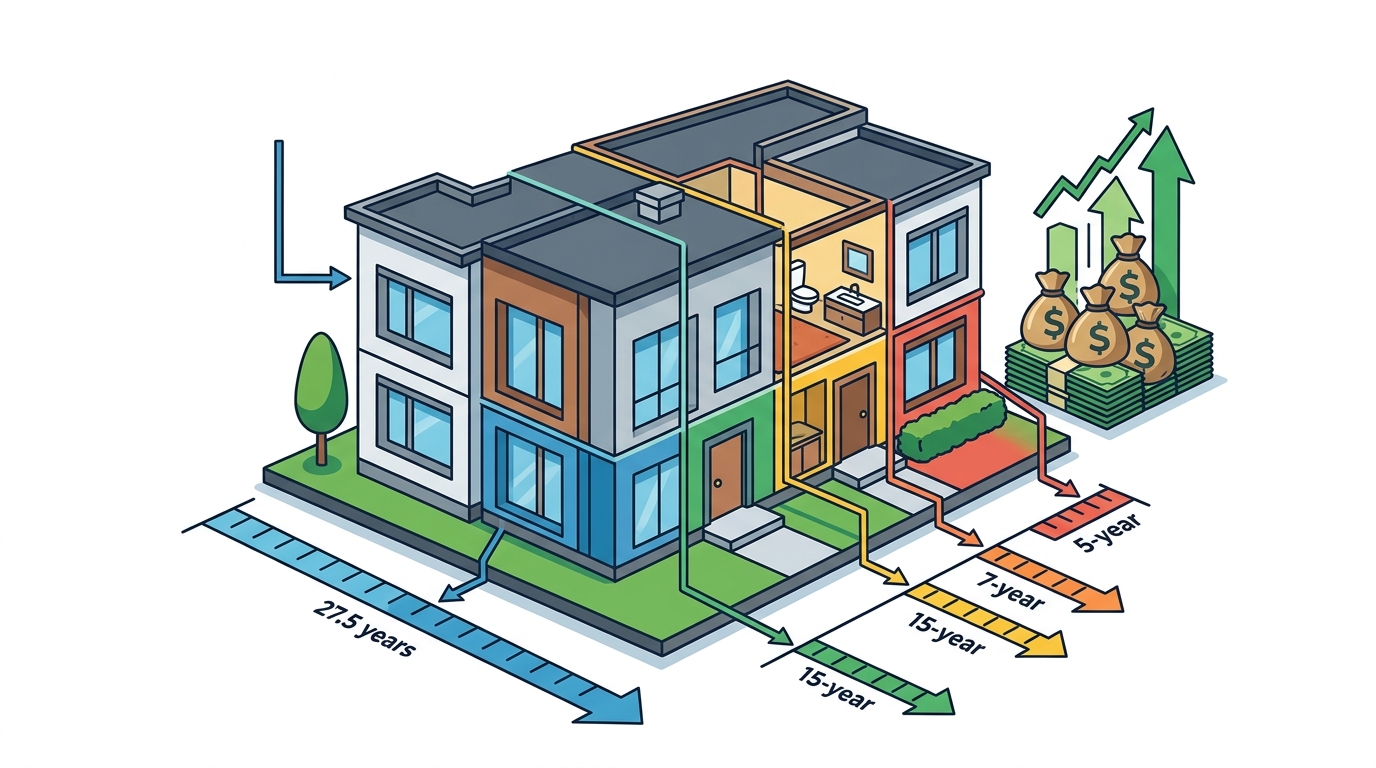
Components in the 5-, 7-, and 15-year buckets depreciate far faster than the 27.5-year building. Here is a breakdown of the common classifications:
- 5-Year Property: Includes carpeting, flooring, appliances, and certain fixtures. These items have a shorter useful life and are often replaced more frequently.
- 7-Year Property: Covers cabinetry, certain equipment, and non-structural improvements. This category often includes built-in shelving and specialized kitchen or bathroom fixtures.
- 15-Year Property: Encompasses land improvements such as landscaping, driveways, fencing, and parking lots. These are tangible assets attached to the land but not the building itself.
- 27.5-Year Property: This is the standard classification for the residential building structure itself, including walls, roofs, and foundations.
Our team analyzes your photos and data to identify components eligible for accelerated depreciation, from flooring and fixtures to fences and driveways, and reviews the classifications before your report is finalized. This smart itemization ensures you capture every possible deduction without overreaching into non-qualifying areas.
The Remote Study Process
Traditionally, cost segregation studies required an on-site visit by an engineer. This approach was time-consuming, expensive, and often impractical for out-of-state investors. RentalWriteOff has revolutionized this process by offering a fully remote study option. We do not do site visits. Every study is built remotely using photos, public records, and satellite imagery.
This remote approach works exceptionally well for residential rentals. The level of detail required to classify assets is often available through high-resolution photos and construction invoices. By leveraging these tools, we can deliver a comprehensive report in just two business days. This speed is unmatched in the industry and allows investors to act quickly on tax opportunities.
The process begins with a simple intake form. You provide basic property details and upload photos of the interior and exterior. Our engineering team then reviews this data to construct a defensible study. The final report includes all necessary schedules, statements, and methodologies required to be compliant with IRS standards. You also receive an itemized CSV listing every classified asset with quantities and values, making it easy to integrate the data into your tax return.
Traditional vs. Cost Segregation
Understanding the difference between traditional depreciation and cost segregation is crucial for making an informed decision. Traditional depreciation spreads your deductions evenly over 27.5 years. Cost segregation front-loads these deductions, providing larger tax benefits in the early years.
| Feature | Traditional Depreciation | Cost Segregation Study |
|---|---|---|
| Depreciation Period | 27.5 years for entire property | 5, 7, 15, and 27.5 years |
| First Year Deduction | Low, spread across all components | High, accelerated for personal property |
| Complexity | Simple, automated | Requires engineering analysis |
| Cost | Minimal | Flat fee (e.g., $899 via RentalWriteOff) |
| Audit Support | Standard IRS guidelines | Detailed documentation and support |
While traditional depreciation is easier to manage, it offers significantly less tax benefit. Cost segregation requires an upfront investment, but the return on that investment is often substantial. For a $500,000 property, the accelerated depreciation can result in tens of thousands of dollars in tax savings in the first year alone.
Key Takeaways
- Cost segregation reclassifies property components into shorter depreciation schedules, accelerating tax deductions.
- RentalWriteOff offers IRS-compliant studies for $899 with a 2-business-day turnaround.
- The strategy is built on the official IRS Cost Segregation Audit Techniques Guide.
- Eligible assets include carpeting, appliances, cabinetry, landscaping, and driveways.
- Remote studies use photos and public records, eliminating the need for site visits.
- Short-term rentals and ADUs are particularly strong candidates for cost segregation.
- Audit support is included with every report to ensure compliance and peace of mind.
Frequently Asked Questions
Does a Cost Segregation Study Require a Site Visit?
No, a site visit is not required. RentalWriteOff conducts studies remotely using photos, public records, and satellite imagery. This approach is efficient and accurate for residential rentals.
How Much Does a Cost Segregation Study Cost?
RentalWriteOff offers a flat fee of $899 for residential rental properties. This price includes a comprehensive report, itemized CSV, and audit support.
Is Cost Segregation Audit-Proof?
While no tax strategy is entirely immune to scrutiny, RentalWriteOff reports are built on IRS guidelines and include detailed documentation. This makes them highly defensible in the event of an audit.
Can I Do Cost Segregation Myself?
Technically, yes, but it is complex and risky. DIY studies often lack the engineering rigor required by the IRS. Professional studies ensure accuracy and compliance.
What Is Bonus Depreciation and How Does It Relate?
Bonus depreciation allows for immediate expensing of qualifying property. Cost segregation identifies the assets that qualify for bonus depreciation, maximizing your first-year deduction.
How Long Does It Take to Receive My Report?
Standard residential reports are delivered in 2 business days after complete intake. This rapid turnaround allows you to file your taxes with confidence.
Does Cost Segregation Work for Short-Term Rentals?
Yes, short-term rentals are excellent candidates. They often contain more personal property, such as furniture and appliances, which can be reclassified for accelerated depreciation.
Get Started Today
Don't let your tax deductions sit idle for 27.5 years. Unlock the full potential of your rental property with a cost segregation study from RentalWriteOff. Our engineering-based approach ensures compliance, speed, and maximum savings. Start your cost segregation study now and see how much you can save. Visit our instant estimate tool to get a free projection of your savings in minutes.