

Cost segregation is a tax strategy that allows real estate investors to accelerate depreciation deductions by reclassifying certain property components into shorter asset lives. According to the Internal Revenue Service, this method can significantly reduce taxable income in the early years of property ownership. For rental property owners, unlocking these accelerated deductions can mean thousands of dollars in immediate cash flow savings, effectively turning paper losses into real financial leverage. (About RentalWriteOff Cost Segregation)
What Is Cost Segregation?
Cost segregation is a specialized engineering-based study that identifies personal property components within a real estate asset. Instead of depreciating the entire building over 27.5 years, this study breaks down the cost basis into shorter recovery periods. The primary goal is to front-load depreciation deductions, thereby reducing current tax liability. (Cost Segregation FAQ for)
Cost segregation is the process of identifying and reclassifying property components to accelerate tax depreciation. This technique is not limited to commercial buildings. It is equally powerful for residential rental properties, including single-family homes, duplexes, and multi-unit complexes. By reclassifying assets, investors can claim larger deductions in the first few years of ownership. (Cost Segregation Studies for)
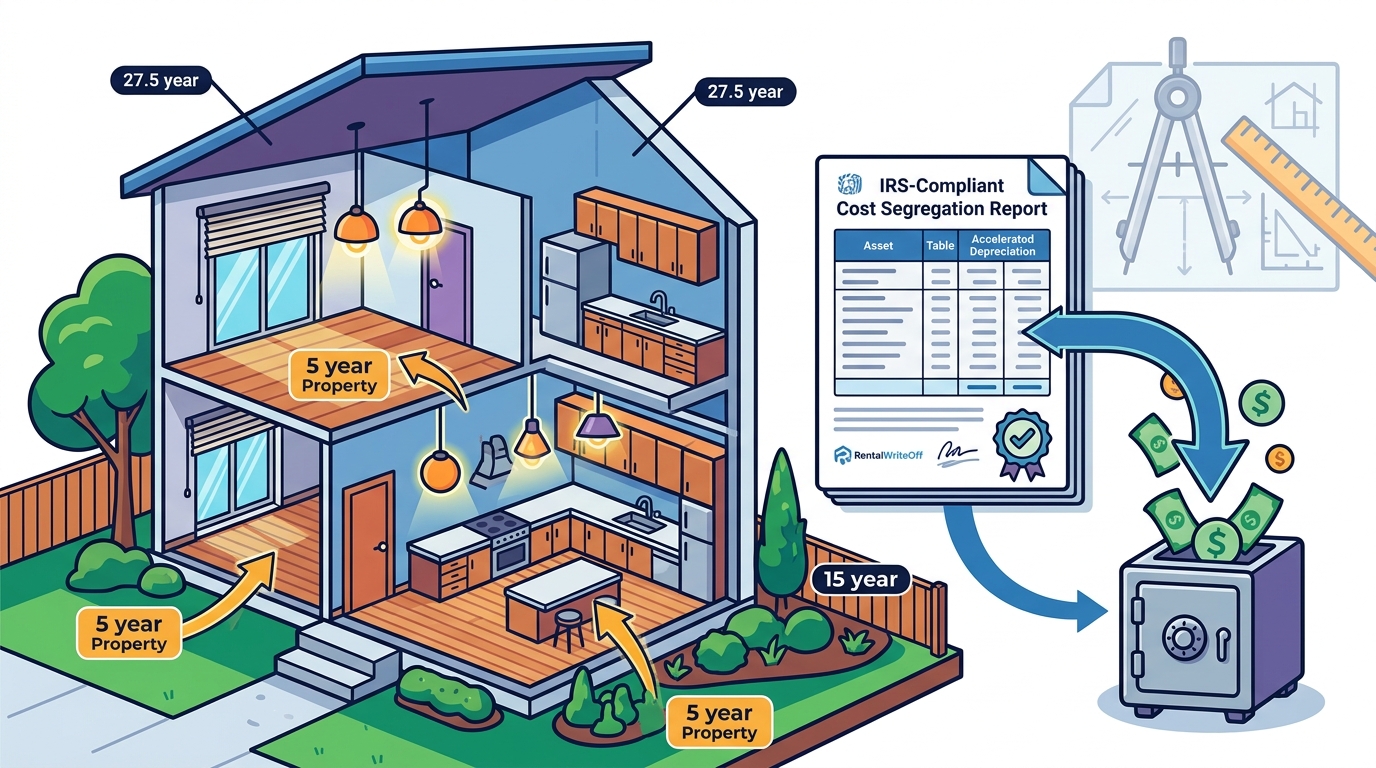
The methodology is built on the official IRS Cost Segregation Audit Techniques Guide. This guide provides the framework for identifying which components qualify for shorter lives. The IRS recognizes that not all parts of a building last 27.5 years. Some components, like flooring or landscaping, have much shorter useful lives. (Rental Property Tax Strategy)
How the Process Works
The cost segregation process involves a detailed analysis of the property. Engineers and tax professionals review construction documents, photos, and cost data to identify eligible assets. These assets are then classified into specific depreciation buckets.
Asset Classification Buckets
Components are typically reclassified into three main categories based on their useful life:
- 5-Year Property: This includes personal property such as carpeting, flooring, appliances, and certain fixtures. These items wear out faster than the building structure.
- 7-Year Property: This category often includes cabinetry, certain equipment, and non-structural components that do not fit into the 5-year or 15-year buckets.
- 15-Year Property: This includes land improvements such as landscaping, driveways, fencing, and parking lots. These assets are subject to wear and tear from the environment.
By moving costs from the 27.5-year building bucket to these shorter buckets, investors can claim significantly larger deductions in the early years. For example, a $500,000 property might have $90,000 reclassified into 5, 7, and 15-year assets. This reclassification can result in an additional $40,000 or more in depreciation deductions in the first year.
The process requires precise documentation. Every classified asset must be supported by quantities and values. This ensures that the study is defensible in the event of an IRS audit. IRS guidelines emphasize the importance of accurate classification and documentation.
Benefits for Short-Term Rentals
Short-term rental (STR) owners, such as Airbnb and VRBO hosts, often see the most dramatic benefits from cost segregation. This is due to the interaction between accelerated depreciation and the STR tax loophole.
The STR Tax Loophole
Short-term rentals with average stays of 7 days or less are not treated as rental activities under IRS rules. This classification is critical. It means that depreciation deductions can offset W-2 and business income, not just rental income. This is a powerful tool for high-income earners who own STR properties.
Material participation is required to utilize the STR tax loophole effectively. Investors must actively run the property and document their hours. If material participation is established, the accelerated depreciation from cost segregation can eliminate taxable income from other sources.
Furnished = Bigger Deductions
STRs are typically furnished with furniture, appliances, decor, and electronics. These items qualify for shorter depreciation schedules. A cost segregation study identifies these components and assigns them to the 5-year or 7-year buckets. This results in even larger deductions compared to unfurnished long-term rentals.
For properties acquired after January 19, 2025, the 100% bonus depreciation rule applies. This means that the reclassified assets can be fully expensed in the first year. Combined with cost segregation, this leads to massive year-one deductions. Tax legislation updates confirm the continuation of these incentives for recent acquisitions.
Long-Term Rental Advantages
While STRs have unique advantages, long-term rental owners also benefit significantly from cost segregation. The primary benefit is the reduction of taxable rental income. This improves cash flow and provides more capital for reinvestment.
For long-term rentals, depreciation deductions are limited to offsetting rental income. However, this can still result in substantial tax savings. The accelerated deductions help offset the income generated by the property, potentially leading to a net operating loss that can be carried forward.
Cost segregation is also valuable for property improvements. If you have made significant renovations to a rental property, a cost segregation study can identify new eligible components. This allows you to claim deductions on the improvement costs in a shorter timeframe.
Audit Support
One of the biggest risks of cost segregation is an IRS audit. The IRS scrutinizes these studies because they involve significant tax savings. RentalWriteOff provides audit support included with every report. This means that if the IRS questions your deductions, you have a team of experts ready to defend your study.
The study includes a complete methodology file citing every IRS regulation used. This documentation is crucial for defending the classifications. IRS audit techniques highlight the need for clear justification of asset lives.
Service Comparison
Not all cost segregation services are created equal. Traditional firms often charge high fees and take weeks to deliver reports. RentalWriteOff offers a streamlined, affordable alternative.
| Feature | Traditional Firms | RentalWriteOff |
|---|---|---|
| Cost | $3,000 - $10,000+ | $899 Flat Fee |
| Turnaround Time | 2-4 Weeks | 2 Business Days |
| Methodology | Varies | IRS-Aligned Engineering |
| Audit Support | Often Extra Cost | Included |
| Target Audience | Commercial Only | Residential & Commercial |
RentalWriteOff democratizes cost segregation by making it accessible to residential rental owners. The flat fee structure removes the barrier of high upfront costs. The 2-day turnaround ensures that investors can plan their tax strategies quickly.
Key Takeaways
- Cost segregation reclassifies property components into shorter depreciation lives, accelerating tax deductions.
- STR owners can offset W-2 income if they meet material participation requirements.
- Properties acquired after January 19, 2025, may qualify for 100% bonus depreciation.
- RentalWriteOff offers IRS-compliant studies for $899 with a 2-day turnaround.
- Audit support is included to protect investors from IRS scrutiny.
- Asset classifications include 5-year, 7-year, and 15-year property buckets.
- The strategy is built on the official IRS Cost Segregation Audit Techniques Guide.
Frequently Asked Questions
What is cost segregation?
Cost segregation is a tax strategy that identifies personal property components within a real estate asset to accelerate depreciation deductions. It reclassifies assets from the 27.5-year building life to shorter 5, 7, or 15-year lives.
Who benefits from cost segregation?
Both short-term and long-term rental property owners benefit. STR owners can offset W-2 income, while long-term owners can reduce taxable rental income and improve cash flow.
How much does a cost segregation study cost?
RentalWriteOff offers a flat fee of $899 for residential properties. Traditional firms often charge significantly more, ranging from $3,000 to over $10,000.
Is cost segregation audit-proof?
While no tax strategy is entirely audit-proof, RentalWriteOff provides audit support included with every report. The study is built on IRS guidelines to ensure defensibility.
Can I do cost segregation on a property I already own?
Yes, you can perform a cost segregation study on properties acquired in the past. You may be able to claim a catch-up adjustment in the current year.
What is the STR tax loophole?
The STR tax loophole allows short-term rental hosts with average stays under 7 days to offset W-2 income with depreciation deductions, provided they meet material participation requirements.
How long does the process take?
RentalWriteOff delivers reports in 2 business days after receiving complete intake data. This is significantly faster than traditional firms that may take weeks.
Get Your Estimate
Stop leaving money on the table. Unlock the tax benefits of cost segregation today. Get your instant, property-specific estimate in minutes. No account required.