

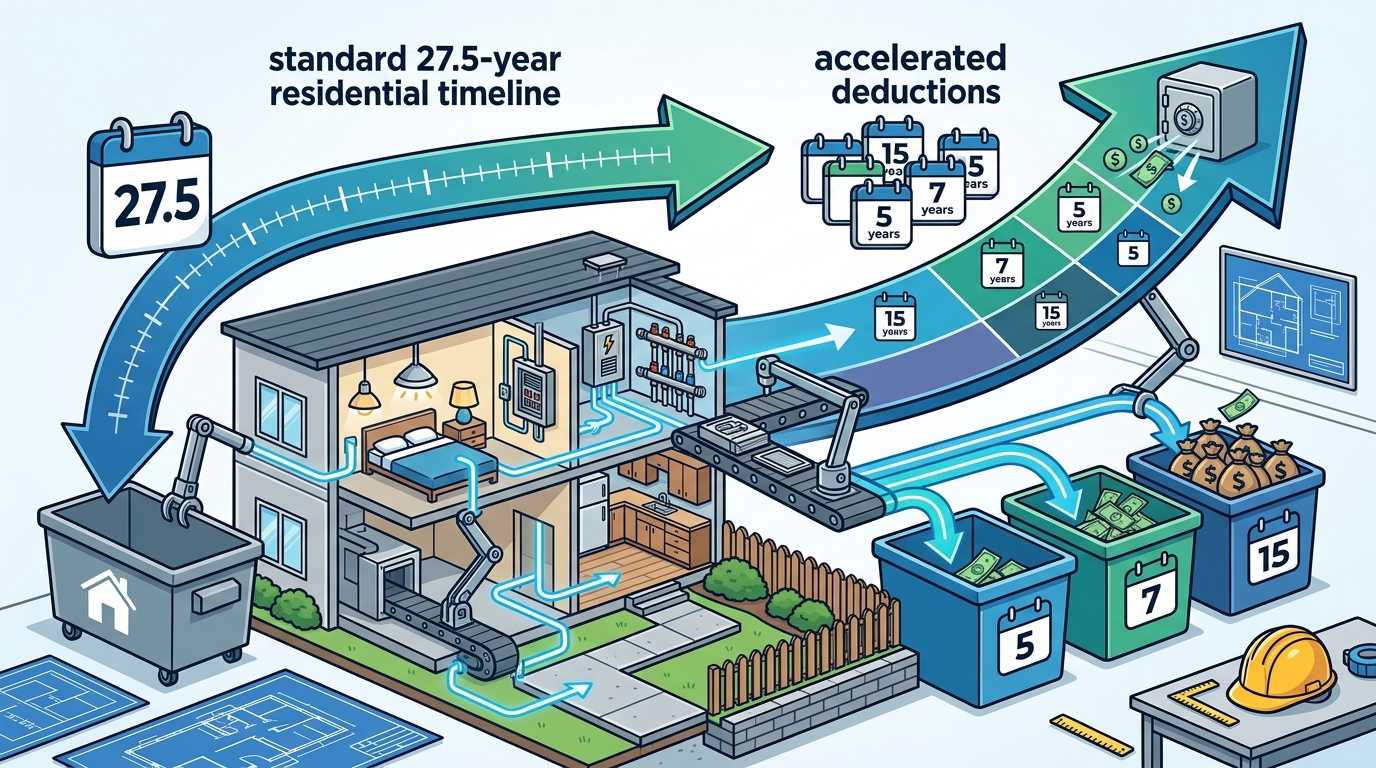
Cost segregation is an IRS-recognized depreciation method that allows property owners to accelerate tax deductions by reclassifying certain building components into shorter asset life categories. According to the IRS Cost Segregation Audit Techniques Guide, this engineering-based approach can significantly reduce taxable income by shifting depreciation from the standard 27.5-year residential timeline to 5, 7, or 15-year schedules. For rental owners, this strategy is not just a theoretical benefit but a practical tool for immediate cash flow improvement. (About RentalWriteOff Cost Segregation)
What Is Cost Segregation?
Cost segregation is the process of identifying and reclassifying components of a building that do not have a predetermined useful life of 27.5 years. Instead of depreciating the entire property value over the standard residential timeline, owners can separate personal property and land improvements into shorter categories. This reclassification is grounded in the official IRS Cost Segregation Audit Techniques Guide, which provides the framework for what qualifies as a valid asset class. (Cost Segregation FAQ for)
The primary goal is to accelerate depreciation deductions. By moving costs from the long-term 27.5-year bucket to 5, 7, or 15-year buckets, property owners can claim much larger deductions in the early years of ownership. This is particularly valuable for those looking to offset other forms of income, such as W-2 wages, provided they meet specific material participation requirements. (Cost Segregation Studies for)
How the Engineering Methodology Works
A professional cost segregation study involves a detailed engineering analysis of the property. This process goes beyond simple accounting estimates and requires a physical or virtual inspection of the asset. The study identifies components that are eligible for accelerated depreciation, such as flooring, cabinetry, appliances, landscaping, and driveways. (Cost Segregation Studies for)
Asset Classification Buckets
Understanding the specific asset classes is critical for maximizing deductions. The engineering methodology typically categorizes assets into the following buckets:
- 5-Year Property: This category includes carpet, appliances, and fixtures. These items have a shorter useful life and are fully depreciated faster.
- 7-Year Property: This often includes cabinetry and certain specialized equipment that does not fit into the building structure.
- 15-Year Property: Land improvements such as landscaping, driveways, and fencing fall into this category.
- 27.5-Year Property: The remaining building structure, including walls, roofs, and foundations, remains in this long-term bucket.
By accurately classifying these components, the study ensures that the highest possible value is assigned to the shortest depreciation periods. This requires defensible pricing and classification for each component, which is reviewed by experts before the final report is delivered.
Benefits for Short-Term Rentals
Short-term rental (STR) owners often find cost segregation even more powerful than long-term rental owners. This is due to the interaction between accelerated depreciation and the tax treatment of STRs. If a property meets the short-stay and material-participation rules, the resulting losses can offset non-rental income.
The STR Tax Loophole
Short-term rentals with average stays of 7 days or less are not treated as rental activity under IRS rules. With material participation, meaning you actively run the property and can document the hours, your depreciation deductions can offset W-2 and business income. This is a significant advantage over long-term rentals, where passive activity loss rules often limit the ability to deduct losses against other income.
Furnished = Bigger Deductions
Furniture, appliances, decor, and electronics in an STR may qualify for shorter depreciation schedules. The property-specific study determines what can be reclassified and documents the allocation. For example, a fully furnished Airbnb might have a substantial portion of its cost basis in 5-year property, leading to massive first-year deductions.
100% Bonus Depreciation in 2026
Property acquired after January 19, 2025, qualifies for 100% first-year bonus depreciation on reclassified assets. Combined with cost segregation, this means massive year-one deductions. For investors buying properties in 2026, this is a critical window to maximize immediate tax savings.
Pricing and Turnaround
Traditional cost segregation studies are often prohibitively expensive for residential property owners, typically costing thousands of dollars and taking weeks to complete. RentalWriteOff has democratized this process by offering a streamlined, affordable solution.
The service provides property-specific, expert-reviewed studies built with an engineering-based methodology for rental owners and their CPAs. The pricing is a flat $899, which includes current-year and look-back studies with Form 3115 included. The turnaround time is remarkably fast, with reports delivered in 2 business days after the intake is complete.
This approach ensures that single-family rental owners can access IRS-compliant studies without compromising quality. Every report includes a final quality check before delivery, ensuring it meets the standard auditors expect. The platform also offers a free estimate in about a minute, allowing owners to see their potential savings before committing.
Traditional vs. Accelerated Depreciation
To understand the impact of cost segregation, it is helpful to compare the standard depreciation method with the accelerated approach. The following table illustrates the difference for a hypothetical $500,000 property.
| Depreciation Method | Asset Class | Allocated Value | Annual Deduction (Year 1) |
|---|---|---|---|
| Standard | 27.5-Year Building | $500,000 | $18,182 |
| Cost Segregation | 5/7/15-Year Assets | $90,000 | $90,000 (with bonus) |
| Cost Segregation | 27.5-Year Building | $410,000 | $14,909 |
| Total Accelerated | Combined | $500,000 | $104,909 |
As shown, the accelerated method can result in significantly higher deductions in the early years. This translates to immediate cash flow benefits and reduced tax liability. The study also provides defensible values and asset classes for each component, ensuring compliance with IRS standards.
Key Takeaways
- Accelerated Deductions: Cost segregation shifts depreciation from 27.5 years to 5, 7, or 15 years, increasing early-year deductions.
- STR Advantage: Short-term rentals can offset W-2 income if material participation rules are met.
- Bonus Depreciation: Properties acquired after January 19, 2025, may qualify for 100% first-year bonus depreciation.
- Affordable Pricing: RentalWriteOff offers a flat $899 price point for residential studies.
- Fast Turnaround: Reports are typically delivered in 2 business days.
- Audit Support: Studies are built on IRS guidelines and include audit support documentation.
- Expert Reviewed: Each report undergoes a final quality check by CPA firms.
Frequently Asked Questions
What is the cost of a cost segregation study?
RentalWriteOff offers a flat fee of $899 for residential cost segregation studies, which includes current-year and look-back studies with Form 3115.
How long does it take to receive the report?
Standard residential reports target a 2-business-day delivery after the complete intake is received.
Is cost segregation only for commercial properties?
No, cost segregation is highly beneficial for residential rental properties, including single-family homes, duplexes, and triplexes.
Can I use cost segregation for a property I already own?
Yes, look-back studies are available for properties acquired in previous years, allowing you to claim missed deductions.
What documentation is included in the study?
The study includes a comprehensive final report, an itemized CSV listing, a methodology file citing IRS regulations, and your complete photo set.
How does cost segregation help with taxes?
It accelerates depreciation deductions, reducing taxable income and potentially offsetting other forms of income like W-2 wages.
Is the study audit-proof?
The methodology is built on the official IRS Cost Segregation Audit Techniques Guide, and each report includes a final quality check to ensure compliance.
Get Your Study
Don't miss out on accelerated tax benefits. Start your cost segregation study today by visiting RentalWriteOff to get your instant estimate or book a consultation. Take advantage of the 2026 bonus depreciation rules and optimize your rental property's tax strategy now.