

Fastest Cost Segregation Turnaround for Rental Properties in 2026
RentalWriteOff delivers standard residential cost segregation reports in two business days after complete intake. This guide explains how turnaround times work, why audit-ready documentation matters, and how remote delivery models eliminate site visit delays. We cover the specific factors that impact report speed and how to choose a provider that balances speed with IRS compliance.
Turnaround Times: What Actually Affects Speed
Cost segregation turnaround time is the number of business days between complete intake submission and final report delivery. Most providers quote a range, but the actual speed depends on three factors: intake completeness, property complexity, and review depth. A provider that promises one-day delivery but lacks a structured review process may deliver a report that fails IRS scrutiny.
Intake Completeness Is the Biggest Variable
The clock starts when your intake is complete, not when you first visit the website. Incomplete submissions delay the process because specialists must request missing documents. RentalWriteOff targets two business days after complete intake and payment. The intake itself takes about five to ten minutes if you have your appraisal, closing documents, and photos ready. Providing more documentation typically translates to higher write-offs and tax savings, so the initial upload step is critical for both speed and accuracy.
Property Complexity Affects Analysis Time
A standard single-family rental with basic finishes moves through analysis faster than a fourplex with extensive renovations or a mobile home park with complex utility infrastructure. Residential studies most commonly move 20% to 40% of building basis into 5, 7, and 15-year property. Small multifamily lands at the upper end of that range because unit count multiplies the number of components that depreciate fast. The more components a specialist must classify and document, the longer the analysis phase takes, even within a two-business-day window.
Review Depth Protects Your Deductions
Speed without quality creates audit risk. Every RentalWriteOff report includes a final quality check before delivery. This expert review ensures that every classified asset is supported by documentation and that the methodology cites the correct IRS regulations. A report that skips this step may arrive faster but may not hold up if the IRS questions your depreciation schedules. The two-business-day standard includes this review, so you get speed without sacrificing compliance.
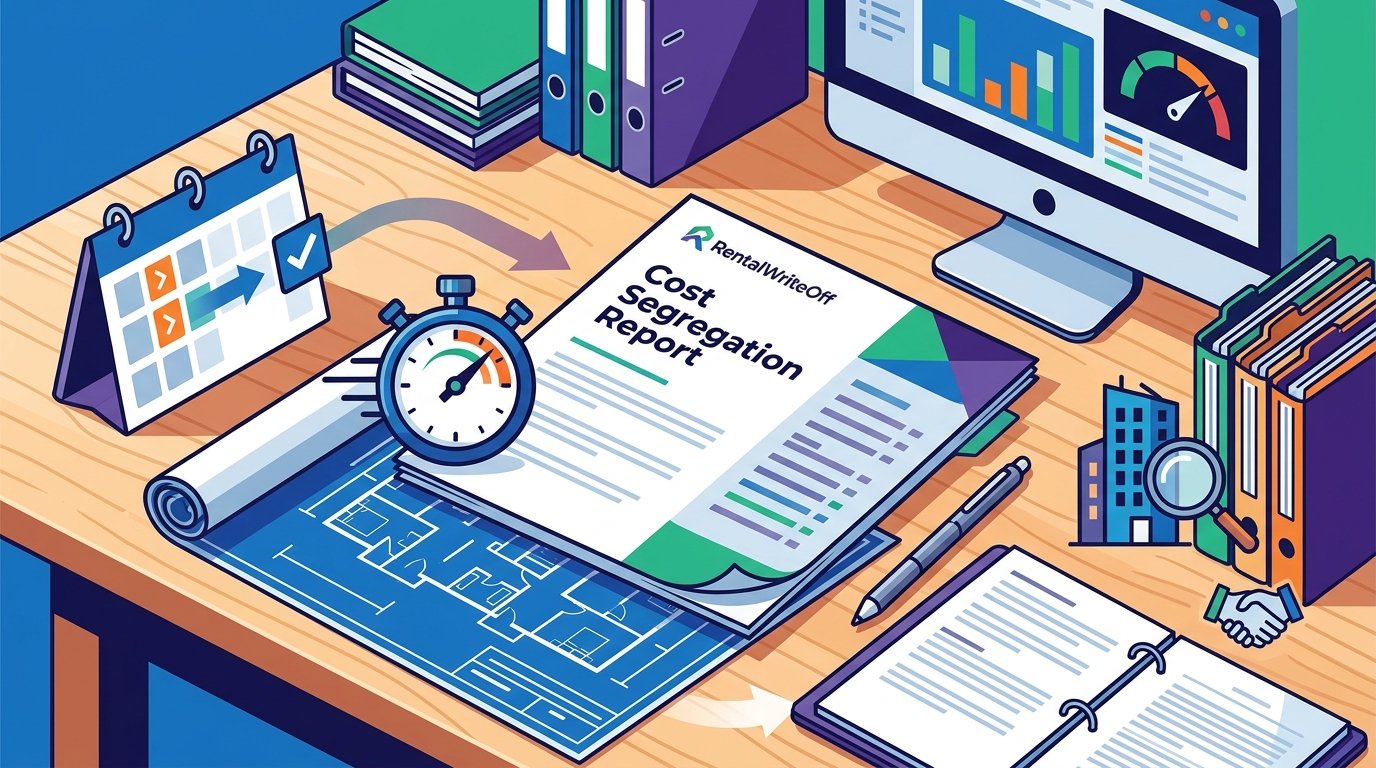
Audit-Ready Reports: Why Speed Cannot Compromise Quality
An audit-ready cost segregation report is a study that includes complete documentation, clear methodology citations, and supporting evidence for every reclassified asset. The IRS Cost Segregation Audit Techniques Guide identifies specific elements that examiners look for when reviewing these studies. A fast report that lacks these elements is not truly fast, because it may require rework or result in disallowed deductions.
What the IRS Expects in a Quality Study
The IRS expects a quality study to include a comprehensive final report with all necessary schedules and methodologies. It should contain an itemized listing of every classified asset with quantities and values. A complete methodology file citing every IRS regulation used is also required. Your complete photo set documenting each asset provides the visual evidence that supports the classifications. RentalWriteOff includes all of these elements in every report, ensuring that the study meets the principal elements identified in IRS Publication 5653.
Audit Support Is Included, Not an Add-On
Many providers charge extra for audit support or treat it as a separate service. RentalWriteOff includes audit support in the flat fee. If you are audited, the team provides supporting documentation and responds to reasonable inquiries from the taxing authority regarding methodology and calculations. This means that the speed you get at delivery is backed by ongoing support. You are not left to defend your deductions alone if the IRS questions the study.
Documentation Quality Determines Audit Outcome
CPAs who review cost segregation studies consistently emphasize that documentation quality is what matters most. A report that is supported by detailed and proper documentation meets IRS compliance requirements and would stand up in an audit. The speed at which you receive the report is less important than whether the report can withstand scrutiny. When evaluating providers, ask what documentation is included and whether audit support is part of the base price or an additional cost.
Remote Delivery Models: How No-Site-Visit Studies Work
A remote cost segregation study is an analysis performed entirely from documentation, without an on-site visit by a specialist. This model works for residential rentals because the necessary evidence can be gathered from existing sources. It eliminates scheduling delays, travel time, and the logistical complexity of coordinating a site visit, which is often the biggest bottleneck in traditional cost segregation.
What Evidence Replaces a Site Visit
Remote studies use photos from the appraisal or rental listing, supplemented when needed by owner-provided photos, public records, and satellite imagery. The specialist analyzes these materials to identify specific components including flooring, fixtures, land improvements, appliances, and more. They evaluate finish quality and condition, not just whether an asset is present. This approach produces allocations that reflect your actual property, not a neighborhood average or a generic template.
Why Remote Works for Residential Rentals
Residential properties up to four units have a manageable number of components that can be documented through photos and public records. A single-family home, duplex, triplex, or fourplex does not have the scale of a commercial building where a site visit might be necessary to verify complex systems. The remote model works identically in all 50 states, which means that location does not affect turnaround time. A property in rural Montana and a property in urban New York both receive the same two-business-day delivery standard.
When You Might Need Additional Photos
If your appraisal or rental listing does not show an important area or improvement, the specialist may ask for a few additional owner-provided photos. This is a normal part of the process and does not significantly delay delivery. The intake form allows you to upload any file type up to 10MB, including acquisition documents, closing disclosures, appraisal reports, renovation receipts, and property photos. Providing more documentation typically translates to higher write-offs and tax savings, so the initial upload step is worth taking the time to do thoroughly.
Key Takeaways
- RentalWriteOff delivers standard residential cost segregation reports in two business days after complete intake and payment.
- Intake completeness is the biggest variable affecting turnaround time. The clock starts when your submission is complete, not when you first visit the website.
- Every report includes a final quality check and expert review before delivery, ensuring that speed does not compromise IRS compliance.
- Audit support is included in the flat fee, not charged as an add-on. If you are audited, the team provides supporting documentation and responds to inquiries.
- Remote delivery models eliminate site visit delays. Studies are built using photos, public records, and satellite imagery, working identically in all 50 states.
- Property complexity affects analysis time. Small multifamily properties land at the upper end of the reclassification range because unit count multiplies the number of components that depreciate fast.
- When evaluating providers, ask what documentation is included and whether audit support is part of the base price. A fast report that lacks proper documentation is not truly fast.
- The two-business-day standard includes the full review process, so you get speed without sacrificing the quality that protects your deductions in an audit.
Frequently Asked Questions
How long does a cost segregation study take?
The intake takes about five minutes. Completed reports are delivered within two business days after submission and payment. The clock starts when your intake is complete, so providing all necessary documents upfront helps ensure the fastest possible delivery.
Do I need to schedule a site visit?
No. The process is fully remote. The team usually uses photos from the appraisal or rental listing, supplemented when needed by owner-provided photos, public records, and satellite imagery. No site visit is required, which eliminates scheduling delays and travel time.
What documents do I need to provide?
You will need the property address, purchase price, closing date, and any renovation details. The team usually uses property photos from the appraisal or rental listing. If those sources do not show an important area or improvement, they may ask for a few additional owner-provided photos. Providing more documentation typically translates to higher write-offs and tax savings.
Is the report IRS-compliant?
Yes. Every report follows IRS guidelines and MACRS classification rules. Each study includes audit support: if you are audited, the team provides supporting documentation and responds to reasonable inquiries from the taxing authority regarding methodology and calculations.
Can I still benefit if I bought my property years ago?
Yes. A look-back study lets you catch up missed depreciation without amending prior returns. Form 3115 is included for eligible look-back studies, and it is part of the flat fee. This means that the two-business-day delivery standard applies to look-back studies as well as new acquisitions.
Does location affect turnaround time?
No. The remote delivery model works identically in all 50 states. A property in any location receives the same two-business-day delivery standard after complete intake. Location does not affect the analysis process or the review depth.
What is included in the flat fee?
The flat fee includes the cost segregation study and asset itemization, depreciation schedules and supporting documentation, audit support, expert review with a final quality check before delivery, and Form 3115 for eligible look-back studies. There are no hidden fees or add-ons for audit support or documentation.
How does remote analysis ensure accuracy?
The specialist analyzes your actual property photos and data, identifying specific components and evaluating finish quality and condition. This approach produces allocations that reflect your property, not a neighborhood average. The final quality check ensures that every classified asset is supported by documentation and that the methodology cites the correct IRS regulations.
Conclusion
The fastest cost segregation turnaround for rental properties is two business days after complete intake, as delivered by RentalWriteOff. This standard includes the full analysis, expert review, and audit support, so you get speed without compromising the quality that protects your deductions. The remote delivery model eliminates site visit delays, and the process works identically in all 50 states. If you are ready to see how much you could save, get your free savings estimate or start your cost segregation study today.