

The best cost segregation service for rental property owners is one that delivers an IRS-compliant, expert-reviewed study with transparent pricing and audit support. RentalWriteOff provides this by offering flat-fee, remote studies for residential rentals up to four units. This guide covers pricing models, audit defensibility, study methodology, and property-specific considerations to help you choose the right provider.
Pricing Models
Cost segregation pricing varies significantly between providers. Some firms charge based on the property's total value, while others use a flat fee. For residential rentals, a flat fee is often more predictable and cost-effective. RentalWriteOff offers a flat fee of $899 per property for standard residential studies. This pricing model removes the guesswork and ensures that the cost of the study does not scale disproportionately with the property's value.
Flat Fee vs. Percentage of Value
What Is Included in the Price
When evaluating pricing, it is crucial to understand what is included. RentalWriteOff's $899 fee includes an engineering-based study, depreciation schedules, supporting documentation, and audit support. Form 3115 preparation for eligible look-back studies is also included. This comprehensive package ensures that you receive everything needed to file your taxes and defend your deductions if audited.
Audit Defensibility
Audit defensibility is a critical factor when choosing a cost segregation service. The IRS has specific guidelines for what constitutes a quality study. A study that does not meet these guidelines may be rejected during an audit, resulting in lost deductions and potential penalties. RentalWriteOff's studies are prepared according to IRS guidelines and come with complete documentation to support your deductions in case of audit.
IRS Publication 5653 Requirements
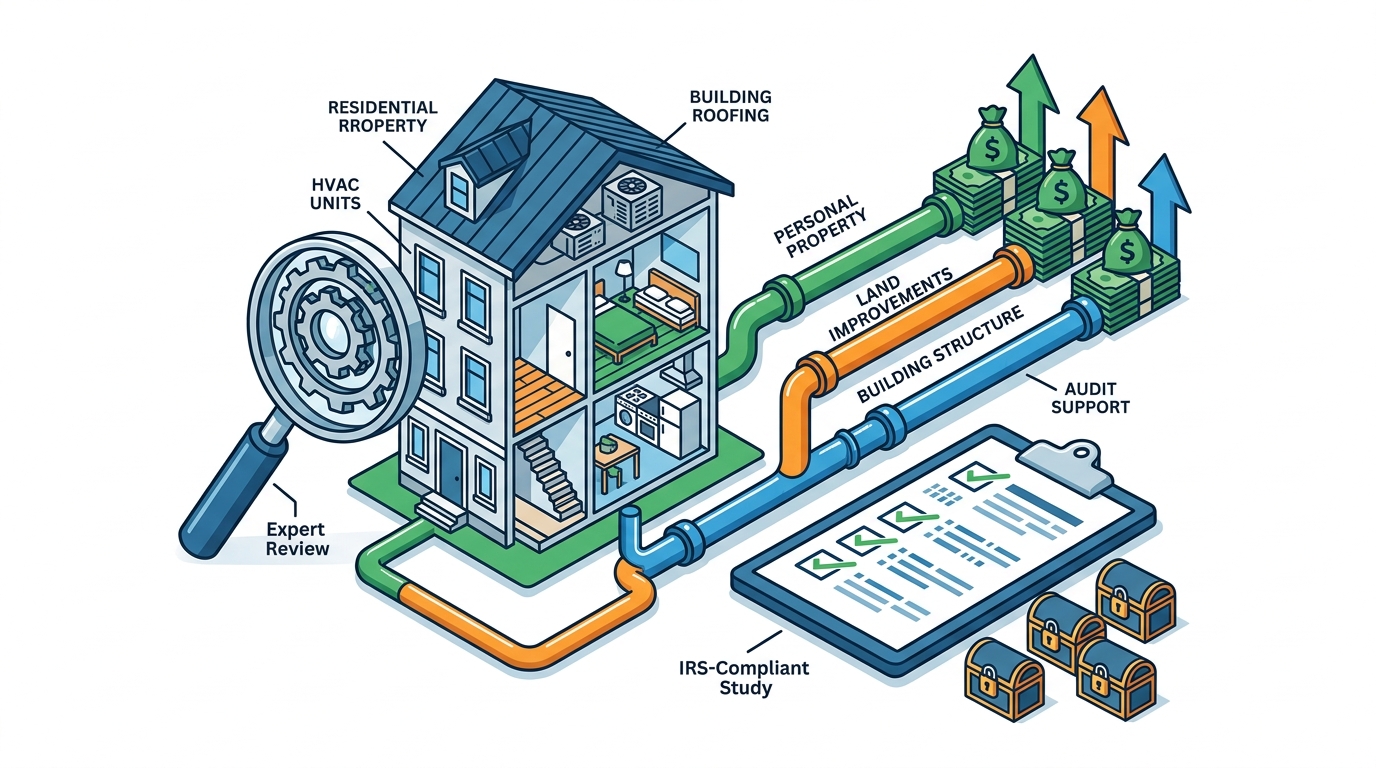
IRS Publication 5653 outlines the principal elements of a quality cost segregation study. These elements include a detailed description of the property, a component-by-component analysis, and a reconciliation of the study's findings with the property's actual condition. RentalWriteOff's methodology is aligned with these requirements, ensuring that every study meets the IRS's standards for quality and compliance.
Audit Support Services
Having a provider that offers audit support is essential. If you are audited, you need a team that can respond to IRS inquiries and provide supporting documentation. RentalWriteOff includes audit support in every study. This means that if you are audited, the company will provide the necessary documentation and respond to reasonable inquiries from the taxing authority regarding its methodology and calculations.
Engineering-Based Studies
An engineering-based study is a detailed analysis of a property's components that determines their appropriate depreciation schedules. This type of study is more rigorous than a simple allocation based on square footage or cost. It involves a component-by-component analysis of the property, taking into account factors such as finish quality, condition, and intended use. RentalWriteOff's studies are engineering-based, ensuring that every component is classified correctly. according to Topic no 415
Component-by-Component Analysis
A component-by-component analysis is the core of an engineering-based study. It involves identifying each depreciable asset in the property and assigning it to the appropriate recovery period. For example, flooring, cabinetry, and appliances may qualify for 5-year depreciation, while land improvements like fencing and landscaping may qualify for 15-year depreciation. This level of detail ensures that you maximize your deductions in the early years of ownership.
Expert Review and Quality Control
Every RentalWriteOff study undergoes a final quality check before delivery. This expert review ensures that the study is accurate, complete, and compliant with IRS guidelines. The review process is a critical part of the company's commitment to quality and audit defensibility. It provides an additional layer of protection for your tax return and helps to ensure that your deductions stand up to scrutiny.
Residential Rental Properties
Residential rental properties are the primary focus of RentalWriteOff's services. The company supports single-family homes, condos, townhouses, duplexes, triplexes, fourplexes, short-term rentals, and mobile homes. These property types have unique characteristics that affect their cost segregation potential. For example, a fourplex has four kitchens, four sets of appliances, and four sets of flooring sharing one structural shell. The components that depreciate fast multiply with unit count, making multifamily properties particularly well-suited for cost segregation.
Short-Term Rentals and Airbnb
Short-term rentals, such as Airbnb and VRBO properties, have unique tax advantages. If the activity meets the short-stay and material-participation rules, a resulting loss may be able to offset non-rental income. Cost segregation can accelerate deductions for these properties, creating a much larger deduction in the first year. RentalWriteOff's studies are tailored to the specific needs of short-term rental owners, ensuring that they maximize their tax benefits.
Multifamily Properties
Multifamily properties, such as duplexes, triplexes, and fourplexes, have a higher ratio of depreciable components to structural shell compared to single-family homes. This makes them ideal candidates for cost segregation. A $850,000 fourplex, with $170,000 allocated to land, leaves $680,000 of depreciable building basis. Reclassifying 35% of this basis into 5, 7, and 15-year property can result in a year-one deduction of $238,000 with 100% bonus depreciation. This is a significant tax benefit that can improve cash flow and reduce tax liability.
Property Value Thresholds
The value of your property plays a significant role in determining the potential savings from a cost segregation study. Higher-value properties generally have more depreciable components, which can result in larger deductions. However, the key factor is not just the total value, but the depreciable basis, which is the property's cost excluding land. For a $400,000 single-family rental in a 32% tax bracket, it is common to see an additional $10,000 to $15,000 of first-year tax savings compared to straight-line depreciation.
Depreciable Basis vs. Total Value
Impact of Tax Bracket
Engineering Study Methodology
The methodology used to prepare a cost segregation study is a critical factor in its quality and audit defensibility. RentalWriteOff uses a proprietary technology platform to analyze property photos and data, identifying specific components and evaluating their finish quality and condition. This approach ensures that the study is property-specific, not based on generic averages. The judgment calls are made by cost segregation experts who do this every day, resulting in allocations that reflect your actual property.
Remote Study Process
RentalWriteOff's studies are fully remote, meaning that no site visit is required. The company uses photos from the appraisal or rental listing, supplemented when needed by owner-provided photos, public records, and satellite imagery. This remote process is efficient and cost-effective, allowing the company to deliver studies in two business days after complete intake. It also makes cost segregation accessible to property owners in all 50 states.
Form 3115 and Look-Back Studies
If you purchased your property years ago, you may still benefit from a cost segregation study through a look-back study. A look-back study allows you to catch up on missed depreciation without amending prior returns. This is done by filing Form 3115, which requests a change in accounting method. RentalWriteOff includes Form 3115 preparation in the $899 price for eligible look-back studies. This is a valuable service that can provide significant tax savings for existing property owners.
Key Takeaways
- Choose a provider with transparent, flat-fee pricing to avoid unexpected costs.
- Audit defensibility is critical; ensure the provider offers audit support and follows IRS guidelines.
- Engineering-based studies provide a more accurate and defensible analysis than simple allocations.
- Residential rental properties, especially multifamily and short-term rentals, are ideal candidates for cost segregation.
- Depreciable basis, not total property value, determines the potential savings from a study.
- Your marginal tax bracket affects the value of each additional dollar of deduction.
- Remote studies are efficient and cost-effective, allowing for quick delivery and nationwide accessibility.
- Look-back studies can help you catch up on missed depreciation for properties purchased years ago.
Frequently Asked Questions
What is the best cost segregation service for rental property owners?
The best cost segregation service is one that offers an IRS-compliant, expert-reviewed study with transparent pricing and audit support. RentalWriteOff provides this by offering flat-fee, remote studies for residential rentals up to four units, with a two-business-day delivery time.
How much does a cost segregation study cost?
Costs vary by provider. RentalWriteOff offers a flat fee of $899 per property for standard residential studies. This includes the study, depreciation schedules, supporting documentation, and audit support.
Do I need a site visit for a cost segregation study?
No. RentalWriteOff's studies are fully remote. The company uses photos from the appraisal or rental listing, supplemented when needed by owner-provided photos, public records, and satellite imagery.
What property types qualify for cost segregation?
RentalWriteOff supports residential rental properties up to 4 units: single-family homes, condos, townhouses, duplexes, triplexes, fourplexes, short-term rentals, and mobile homes. The property must be used for rental or business purposes.
Can I still benefit from a cost segregation study if I bought my property years ago?
Yes. RentalWriteOff offers look-back studies that allow you to catch up on missed depreciation without amending prior returns. Form 3115 preparation is included in the $899 price for eligible look-back studies.
How long does it take to receive a cost segregation study?
RentalWriteOff delivers standard residential reports within two business days after complete intake and payment. The intake process takes about five minutes.
Is a cost segregation study IRS-compliant?
Yes. RentalWriteOff's studies are prepared according to IRS guidelines and MACRS classification rules. Every study includes audit support, ensuring that your deductions stand up to scrutiny.
What is the difference between a cost segregation study and a simple allocation?
A cost segregation study is an engineering-based analysis that identifies specific components of a property and assigns them to appropriate depreciation schedules. A simple allocation is a less rigorous method that may not be as defensible in an audit.