What Is Cost Segregation? The Ultimate Guide for Rental Owners
What Is Cost Segregation? The Ultimate Guide for Rental Owners Cost segregation is an IRS-recognized tax strategy that reclassifies parts of your rental property into shorter depreciation schedules, cutting your tax bill in the early years of ownersh...
Cost segregation is an IRS-recognized tax strategy that reclassifies parts of your rental property into shorter depreciation schedules, cutting your tax bill in the early years of ownership. According to the IRS Cost Segregation Audit Techniques Guide, this engineering-based approach allows property owners to accelerate depreciation deductions by identifying personal property components that would otherwise be depreciated over 27.5 years. For many rental investors, this strategy unlocks immediate cash flow improvements by shifting massive deductions from the future to the present. The process involves a detailed analysis of property components, separating land, building structure, and personal property to maximize early-year tax benefits. This guide explains exactly how the mechanism works, why it matters for your portfolio, and how to implement it safely.
What Is Cost Segregation?
Cost segregation is the process of identifying and reclassifying assets within a real estate property to accelerate depreciation deductions. Instead of depreciating the entire property cost over 27.5 years for residential rentals, owners can separate components into 5, 7, or 15-year classes. This reclassification is based on the physical nature of the asset and its intended use, not just its location within the building.
The core concept relies on the IRS definition of tangible personal property versus real property. Personal property is defined as property that is movable and not permanently attached to the land or building structure. By identifying these components, investors can claim larger deductions in the first year of ownership. This is particularly powerful when combined with bonus depreciation provisions. For properties acquired after January 19, 2025, 100% bonus depreciation is permanent under federal law, allowing for even faster write-offs. The strategy is not limited to new construction; it can be applied to existing properties through a retrospective study.
How the Engineering Analysis Works
A professional cost segregation study is an engineering-based analysis that requires specialized knowledge of construction costs and tax law. The process begins with the collection of historical data, including purchase agreements, construction invoices, and architectural plans. For existing properties, public records and satellite imagery often supplement this data. The analysis team then categorizes every component of the property into specific depreciation classes.
The classification typically follows these standard buckets:
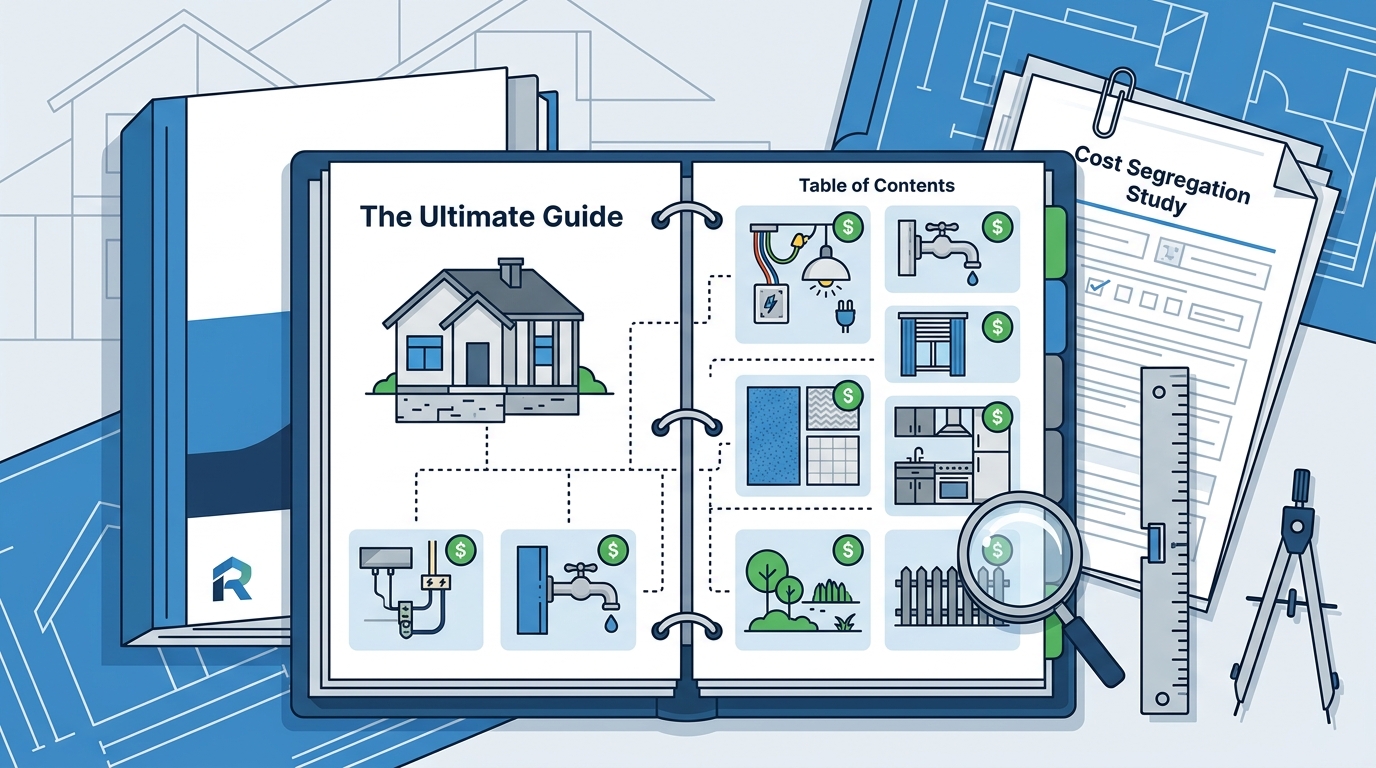
5-Year Property: Includes carpeting, flooring, lighting fixtures, and certain electrical components. (Cost Segregation Studies for)
7-Year Property: Includes cabinetry, appliances, and certain types of equipment. (Cost Segregation FAQ for)
15-Year Property: Includes landscaping, driveways, fencing, and paving.
27.5-Year Property: The remaining building structure, including walls, roof, and foundation.
The accuracy of this classification is critical. Depreciation is defined as the allocation of the cost of a tangible asset over its useful life. Misclassifying an asset can lead to IRS penalties or audit triggers. Therefore, the study must be defensible and compliant with IRS guidelines. RentalWriteOff utilizes a rigorous quality check process to ensure every report meets these standards. The final output includes a detailed report with schedules, statements, and methodologies that support the deductions claimed on your tax return.
Key Benefits for Rental Owners
The primary benefit of cost segregation is the acceleration of tax deductions. By moving depreciation from the 27.5-year bucket to shorter life categories, investors can significantly reduce their taxable income in the early years of ownership. This reduction in taxable income translates directly to cash flow savings. For example, a study on a $500,000 property might identify $90,000 in assets eligible for 5, 7, or 15-year depreciation. This results in a substantial increase in first-year deductions compared to standard depreciation.
Another major benefit is the ability to offset passive income. Rental income is typically considered passive, and losses from depreciation can offset this income. This is especially valuable for high-income investors who are subject to passive activity loss rules. Cost segregation can create or increase passive losses, providing a tax shield against other income. Additionally, the strategy can be applied to existing properties, allowing owners to recapture missed deductions from previous years. This retrospective application can result in significant back-tax savings.
Eligibility and Property Types
Cost segregation is available for a wide range of property types, including single-family rentals, multi-family units, and commercial properties. The strategy is particularly effective for properties that have undergone recent renovations or new construction. Real property is defined as land and anything permanently attached to it, such as buildings and structures. However, components within these structures can often be reclassified as personal property.
Short-term rentals, such as Airbnb and VRBO properties, are also strong candidates for cost segregation. The IRS treats short-term rentals similarly to long-term rentals for depreciation purposes, provided they meet certain usage thresholds. Mobile home parks and manufactured housing units may have unique considerations, but the core principles of cost segregation still apply. The key is to identify components that are not permanently affixed to the land. For instance, appliances and fixtures in a mobile home can often be depreciated over shorter periods.
Standard vs. Cost Segregation Depreciation
Understanding the difference between standard depreciation and cost segregation is essential for evaluating the strategy. Standard depreciation spreads the cost of the building evenly over 27.5 years. This results in small, consistent annual deductions. Cost segregation, on the other hand, front-loads these deductions by identifying components that can be depreciated faster.
Feature
Standard Depreciation
Cost Segregation Study
Depreciation Period
27.5 years
5, 7, 15, and 27.5 years
First-Year Deduction
Low
High (Accelerated)
Complexity
Simple
Requires Engineering Analysis
Audit Risk
Low
Low (if IRS-compliant)
Cash Flow Impact
Minimal
Significant
The table above illustrates the stark contrast in cash flow impact. While standard depreciation is simpler, it offers limited immediate tax benefits. Cost segregation requires an upfront investment in the study but provides a much higher return on investment through accelerated deductions. The cost of the study is typically recovered within the first few years of ownership due to the increased tax savings.
Key Takeaways
Cost segregation reclassifies property components into shorter depreciation lives (5, 7, or 15 years).
The strategy is based on the IRS Cost Segregation Audit Techniques Guide.
100% bonus depreciation is permanent for qualifying property acquired after January 19, 2025.
RentalWriteOff offers IRS-compliant studies with a 2-business-day turnaround.
The service includes audit support and detailed documentation for every asset.
Cost segregation can be applied to existing properties for retrospective tax savings.
The strategy is effective for single-family, multi-family, and short-term rentals.
Frequently Asked Questions
Is cost segregation legal?
Yes, cost segregation is a legal IRS-recognized tax strategy. It is based on the principle that certain components of a building are personal property and should be depreciated over a shorter life. The IRS provides specific guidelines, known as the Cost Segregation Audit Techniques Guide, to ensure compliance.
How much does a cost segregation study cost?
Costs vary depending on the size and complexity of the property. RentalWriteOff offers a flat-rate pricing model for residential rental properties, making the service accessible to individual investors. The cost is typically offset by the tax savings in the first year of ownership.
Do I need a site visit for the study?
Not necessarily. Many studies, including those from RentalWriteOff, are conducted remotely using photos, public records, and satellite imagery. This approach is efficient and accurate for most residential rental properties.
Can I do cost segregation on an existing property?
Yes, you can apply cost segregation to existing properties. This is known as a retrospective study. You can amend past tax returns to claim missed deductions, subject to IRS statute of limitations.
What is the difference between 5-year and 7-year property?
5-year property typically includes items like carpeting and lighting fixtures. 7-year property often includes cabinetry and appliances. The classification depends on the specific use and attachment of the component.
How long does the study take?
RentalWriteOff delivers standard residential reports in 2 business days after receiving complete intake data. This rapid turnaround allows investors to plan their tax strategies effectively.
Is the report audit-proof?
While no tax strategy is entirely immune to audit, RentalWriteOff reports are designed to be audit-ready. They include detailed documentation, methodologies, and support from CPA firms to defend the classifications.
Start Your Cost Segregation Study
Unlock the tax benefits of cost segregation today. RentalWriteOff provides engineering-based, IRS-compliant studies tailored for rental property owners. Get your report in 2 business days with audit support included. Start your cost segregation study now and see how much you can save. Visit our pricing page for details. Learn more about our mission and methodology. Check our blog for more tax strategies. Contact us at support@rentalwriteoff.com for questions.