

Step-by-Step Process for Filing a Look-Back Cost Segregation Study on Your Rental Property
According to the Internal Revenue Service, cost segregation is a legitimate accounting method that allows property owners to accelerate depreciation deductions by reclassifying certain building components into shorter asset classes. For rental property owners, this strategy can unlock significant cash flow by shifting depreciation from the standard 27.5-year schedule to 5, 7, or 15-year categories. A look-back study specifically targets properties already in service, allowing you to claim missed deductions from previous tax years through a retroactive filing process. (About RentalWriteOff Cost Segregation)
Understanding the Look-Back Study Mechanism
Cost segregation is the practice of identifying personal property within a real estate asset that qualifies for shorter depreciation lives. Cost segregation is a tax strategy that reclassifies building components into shorter depreciation schedules. When you purchase or construct a rental property, the IRS typically requires you to depreciate the entire structure over 27.5 years for residential properties. However, many components of that building, such as flooring, landscaping, and fixtures, do not last that long and should be depreciated much faster.
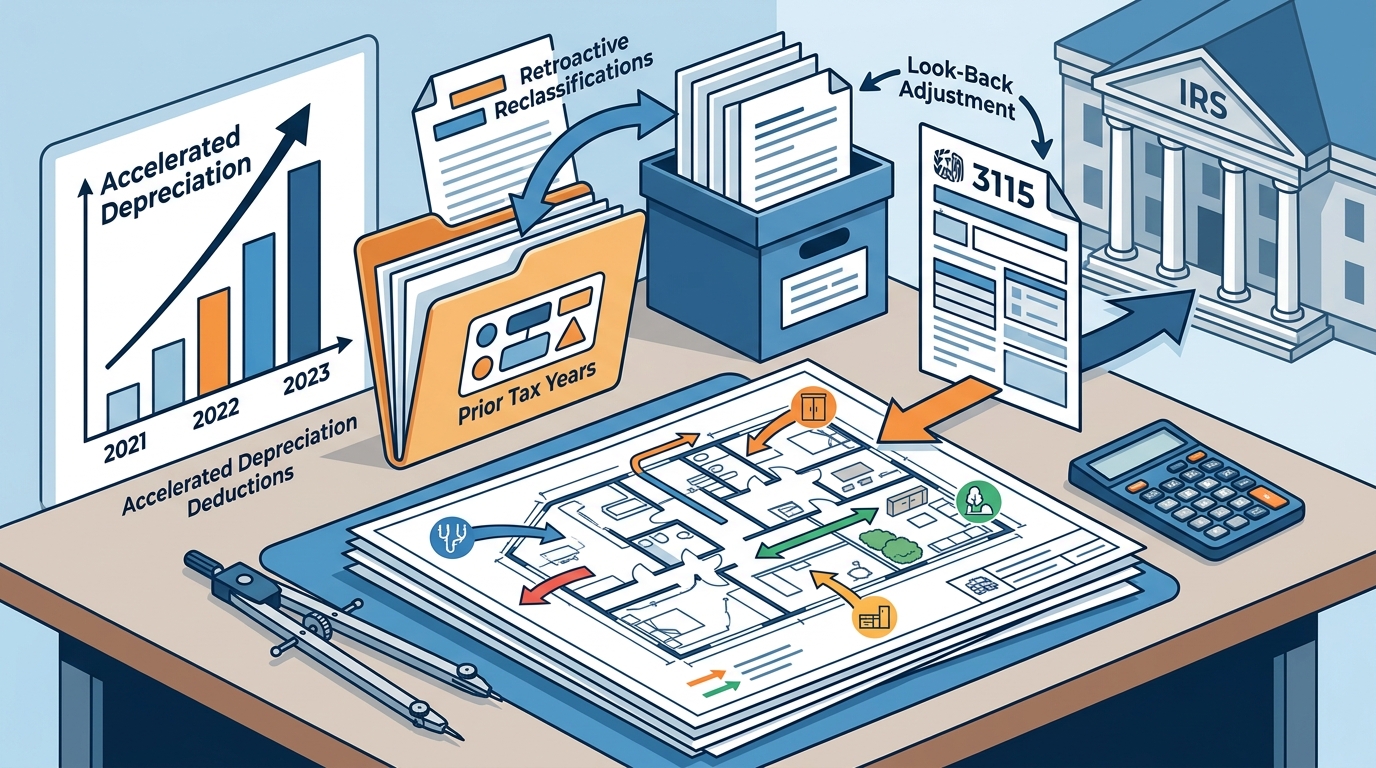
A look-back cost segregation study applies this analysis to properties that were placed in service in prior years. Instead of waiting for future years to claim these deductions, you file an amended return or a change in accounting method to claim the missed depreciation all at once. This creates a massive one-time deduction that can offset other income, such as W-2 wages or business profits, depending on your participation level in the rental activity.
Determining Your Eligibility for Retroactive Filing
Not every property owner is an ideal candidate for a look-back study, though the potential savings often outweigh the administrative effort. The primary requirement is that the property must have been placed in service after 1987, when the current depreciation rules were established. If you own a historic property acquired before this date, the rules may differ significantly.
For short-term rental owners, the benefits are often amplified. If your property qualifies as a short-term rental with average stays of seven days or less, and you meet the material participation requirements, the accelerated depreciation can offset non-passive income. This is a critical distinction because standard long-term rental losses are often limited by passive activity rules. Short-term rentals with average stays under seven days may qualify for non-passive loss treatment.
You should also consider the age of your property. The older the property, the more likely it is that the initial construction costs were fully depreciated or that the opportunity to accelerate deductions has grown. However, even newer properties can benefit if the initial cost segregation study was incomplete or if the property underwent significant renovations that were not properly segregated.
Gathering Property Data and Documentation
The foundation of a defensible look-back study is accurate data. Unlike generic estimates, a property-specific analysis requires detailed information about the physical asset. This phase involves collecting purchase contracts, closing statements, and construction records. These documents provide the total cost basis of the property, which is the starting point for all depreciation calculations.
For properties where original construction documents are lost, a physical inspection or detailed photo review becomes essential. Property-specific analysis relies on accurate cost basis data from closing statements. You will need to provide square footage, lot size, year built, and a detailed inventory of improvements made since acquisition. This data allows engineers to allocate costs to specific asset classes with precision.
At RentalWriteOff, we streamline this process by using a structured intake form that guides you through the necessary data points. We analyze your photos and data to identify components eligible for accelerated depreciation. This includes everything from cabinetry and appliances to driveways and fencing. The more detailed your input, the more accurate the resulting study will be.
The Engineering-Based Analysis Phase
Once the data is collected, the engineering analysis begins. This is where the technical expertise comes into play. Engineers use the IRS Cost Segregation Audit Techniques Guide as the primary framework for classifying assets. This guide provides the authoritative standards for determining which components qualify for 5, 7, or 15-year depreciation lives.
The analysis involves breaking down the property into its constituent parts. For example, carpet and appliances are typically classified as 5-year property. Cabinetry and certain equipment often fall into the 7-year category. Landscaping, driveways, and fencing are generally classified as 15-year property. The building structure itself remains a 27.5-year asset.
Our team prepares defensible values and asset classes for each component. This is not a guesswork exercise. Each allocation is supported by engineering principles and IRS regulations. The final report includes all necessary schedules, statements, and methodologies required to be compliant with IRS standards. This audit-ready documentation is crucial for defending your deductions in the event of an IRS review.
Filing Form 3115 with the IRS
The final and most critical step is the actual filing of the change in accounting method. This is done using Form 3115, Application for Change in Accounting Method. The look-back study provides the technical report, but the CPA must file the form to legally implement the change in depreciation method.
The filing process involves submitting Form 3115 to the IRS National Office. The form must be attached to your tax return for the year of change. If you are amending prior years, you will also need to file Form 1040-X for each affected year. The IRS typically grants automatic consent for this type of change, but the filing must be precise to avoid delays or rejections.
RentalWriteOff includes Form 3115 preparation in our standard service. We ensure that the technical data from the study aligns perfectly with the requirements of the form. This reduces the risk of errors and ensures a smooth filing process. Our reports are vetted by CPA firms to ensure they meet the highest standards of compliance and accuracy.
Calculating Your Tax Savings and Cash Flow
The ultimate goal of a look-back cost segregation study is to improve your cash flow. By accelerating depreciation, you reduce your taxable income in the current year and in prior years. This results in a tax refund or a significant reduction in your current tax liability.
For example, on a $500,000 property, a typical cost segregation study might reclassify $90,000 of the cost basis into shorter asset classes. This can result in an additional $40,000 or more in depreciation deductions in the first year. When combined with the look-back provision, the total savings can be substantial, often covering the cost of the study multiple times over.
It is important to note that the tax impact varies based on your individual tax situation. Factors such as your marginal tax rate, the presence of other deductions, and your passive activity status all play a role. However, the general trend is clear: cost segregation is one of the most effective tools for rental property owners to maximize returns and minimize tax burden.
Key Takeaways
- A look-back cost segregation study allows you to claim missed depreciation deductions from prior years by filing Form 3115.
- The strategy is built on the official IRS Cost Segregation Audit Techniques Guide for defensible asset classification.
- Short-term rentals with average stays under seven days may offset non-passive income, enhancing the value of accelerated deductions.
- RentalWriteOff offers a flat fee of $899 for residential studies with a standard 2-business-day turnaround.
- The process includes property-specific analysis, expert review, and complete Form 3115 preparation.
- Audit support is included with every report to ensure compliance and defend your deductions.
- Properties placed in service after 1987 are generally eligible for this retroactive filing method.
Frequently Asked Questions
What is a look-back cost segregation study?
A look-back cost segregation study is a retroactive analysis of a property already in service. It identifies components that should have been depreciated over shorter lives and allows the owner to claim those missed deductions through a change in accounting method.
How long does the filing process take?
The engineering analysis typically takes two business days after all data is received. The IRS filing process via Form 3115 is automatic for most residential properties, but the tax return preparation and submission depend on your CPA's timeline.
Can I file a look-back study for a property I bought years ago?
Yes, as long as the property was placed in service after 1987. The look-back provision allows you to claim deductions for all prior years up to the current tax year, subject to statute of limitations rules.
Is the cost segregation report audit-proof?
While no document is entirely immune to scrutiny, RentalWriteOff reports are built on IRS guidelines and include detailed methodology files. This audit-ready documentation is designed to withstand IRS review and defend the classifications used.
Do I need a CPA to file Form 3115?
Yes, Form 3115 must be filed by a tax professional. RentalWriteOff provides the technical report and Form 3115 preparation, but your CPA must review and submit the form to the IRS.
What documents do I need to provide?
You will need purchase contracts, closing statements, construction records, and photos of the property. If original documents are unavailable, we can work with alternative data sources to build a defensible study.
How much can I save with a look-back study?
Savings vary based on property value and cost basis. However, many owners see savings that exceed the cost of the study by a factor of ten or more, especially when considering the time value of money and immediate cash flow improvement.
Start Your Look-Back Study Today
Don't leave money on the table. A look-back cost segregation study is a powerful tool for rental property owners to optimize their tax strategy and improve cash flow. With RentalWriteOff, you get property-specific, expert-reviewed studies delivered in just two business days. Our engineering-based methodology ensures compliance with IRS standards, giving you the confidence to file with assurance.
Calculate your potential savings now with our free estimator or start your study today. Take control of your rental property's tax future with a solution built for efficiency, accuracy, and maximum return.