

Accelerating tax deductions is the single most effective way to improve cash flow for rental property owners. According to the IRS, cost segregation studies can accelerate depreciation by accelerated depreciation of up to 80% in the first year. This massive shift in timing transforms passive losses into immediate tax shields. Understanding the mechanical differences between standard depreciation and cost segregation is critical for maximizing your return on investment. (About RentalWriteOff Cost Segregation)
Understanding Standard Depreciation
Standard depreciation is the default method the IRS requires for residential rental properties. It assumes that the entire building, excluding the land value, loses value over a fixed period. This method is simple to calculate but offers minimal immediate tax relief. (Cost Segregation FAQ for)
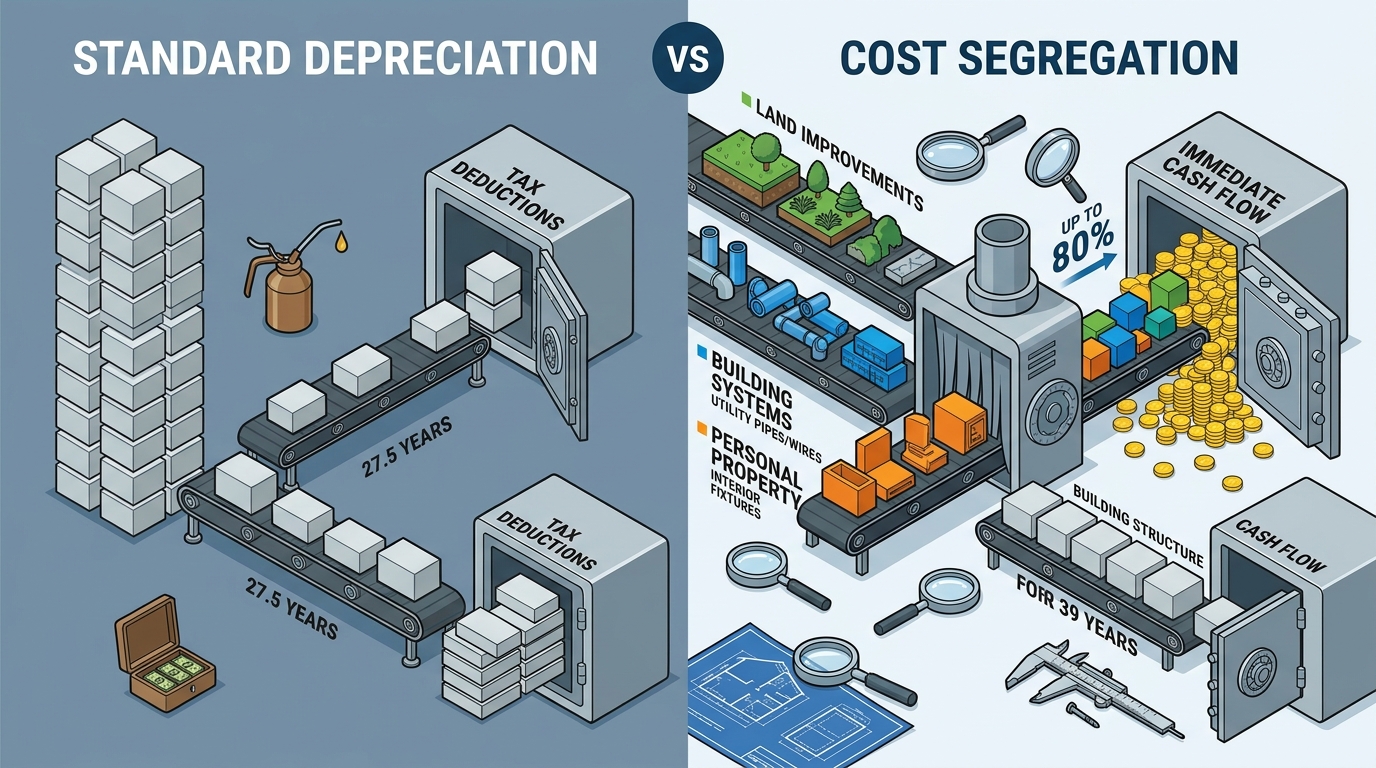
Standard depreciation is a straight-line method that spreads the cost of a residential rental property over 27.5 years. This means that for every dollar you spend on the structure, you can only deduct a tiny fraction each year. For a $500,000 property, the annual deduction is roughly $18,181. While this provides consistent deductions, it does not address the rapid wear and tear of specific components like carpets, appliances, or landscaping. (Cost Segregation Studies for)
The limitation of this approach is that it ignores the reality of property components. A new roof might last 20 years, but a carpet might only last five. Standard depreciation forces you to depreciate the carpet over 27.5 years, even though it will likely need replacement long before that period ends. This mismatch between economic life and tax life results in delayed tax benefits and higher current-year tax liabilities. (Cost Segregation Studies for)
The Cost Segregation Advantage
Cost segregation is a strategic tax tool that reclassifies certain property components into shorter depreciation lives. Instead of treating the building as a single asset, this method breaks it down into its constituent parts. This allows property owners to claim accelerated depreciation on assets that would otherwise be locked into the 27.5-year schedule.
Cost segregation is an IRS-recognized method that identifies personal property and land improvements eligible for shorter depreciation lives. These assets are typically categorized into 5, 7, or 15-year classes. By moving costs from the 27.5-year bucket to these shorter buckets, you can deduct a much larger portion of your property's value in the early years of ownership.
The engineering-based methodology used by experts like RentalWriteOff ensures that every classification is defensible. The process involves analyzing blueprints, photos, and construction costs to identify items such as flooring, cabinetry, lighting, and fencing. These items are then assigned to the appropriate IRS asset class. The result is a significant increase in first-year deductions, often ranging from 20% to 40% of the total property cost.
Key Differences at a Glance
To visualize the financial impact, consider the following comparison between standard depreciation and a typical cost segregation study for a $500,000 residential rental property.
| Feature | Standard Depreciation | Cost Segregation Study |
|---|---|---|
| Depreciation Period | 27.5 years for the entire structure | 5, 7, 15, and 27.5 years |
| First-Year Deduction | ~$18,181 | ~$90,000+ |
| Complexity | Low, automated calculation | High, requires engineering analysis |
| Audit Risk | Minimal, standard practice | Low with proper documentation |
| Cash Flow Impact | Minimal immediate benefit | Significant tax savings and cash back |
The table above highlights the dramatic difference in cash flow. While standard depreciation offers predictability, cost segregation offers power. The ability to deduct $90,000 in the first year versus $18,181 can mean the difference between owing taxes and receiving a refund. This is particularly true for investors in higher tax brackets.
Impact on Short-Term Rentals
For owners of Airbnb, VRBO, or other short-term rental properties, the benefits of cost segregation are even more profound. The IRS has specific rules regarding short-term rentals that can turn depreciation deductions into a powerful tool for offsetting other income.
Short-term rentals with average stays of 7 days or less are not treated as rental activity under IRS rules. This classification is crucial because it allows depreciation deductions to offset non-rental income, such as W-2 wages or business profits. This is often referred to as the "STR Tax Loophole." Without cost segregation, you are limited to the small 27.5-year deductions. With it, you can generate substantial losses that reduce your overall tax burden.
Furthermore, short-term rentals are typically furnished with items like furniture, appliances, and decor. These items qualify for the shortest depreciation lives (5 or 7 years). A cost segregation study ensures these assets are properly identified and valued. For properties acquired after January 19, 2025, the 100% bonus depreciation rule allows you to deduct the entire cost of these reclassified assets in the first year. This combination of cost segregation and bonus depreciation creates an unprecedented opportunity for tax savings.
Audit Readiness and Documentation
One of the primary concerns investors have with cost segregation is the risk of an IRS audit. The IRS scrutinizes these studies because they significantly reduce tax liability in the early years. However, a well-documented study is your best defense against scrutiny.
Audit-ready documentation includes detailed schedules, statements, and methodologies required to be compliant with IRS standards. RentalWriteOff builds its methodology on the official IRS Cost Segregation Audit Techniques Guide. This ensures that every classification and valuation is supported by authoritative sources. The final report includes an itemized CSV listing every classified asset, along with the complete methodology file citing every IRS regulation used.
Having a defensible study means you can confidently file your taxes knowing that the positions taken are supportable. The engineering-based approach removes the guesswork and provides a clear trail of evidence. This level of detail is what separates professional studies from generic estimates. It also provides peace of mind for both the property owner and their CPA.
Key Takeaways
- Accelerated Deductions: Cost segregation can increase first-year deductions by up to 80% compared to standard depreciation.
- STR Benefits: Short-term rental owners can offset W-2 income using depreciation deductions if they meet material participation rules.
- Bonus Depreciation: Properties acquired after January 19, 2025, may qualify for 100% first-year bonus depreciation on reclassified assets.
- Audit Defense: Studies built on the IRS Audit Techniques Guide provide a strong defense against scrutiny.
- Component Analysis: Items like flooring, cabinetry, and landscaping are often eligible for 5, 7, or 15-year depreciation.
- Cash Flow: Immediate tax savings translate directly to increased cash flow for reinvestment.
- Professional Review: Expert-reviewed reports ensure accuracy and compliance with current tax laws.
Frequently Asked Questions
Is cost segregation worth the cost for a single rental property?
Yes, for most rental properties valued over $200,000, the tax savings in the first year typically exceed the cost of the study. RentalWriteOff offers a flat fee of $899, making it accessible for single-family rentals.
How long does it take to receive a cost segregation report?
RentalWriteOff delivers standard residential reports in 2 business days after receiving complete intake information. This rapid turnaround allows you to file your taxes on time.
Can I do a cost segregation study on a property I already own?
Absolutely. You can file a look-back cost segregation study using Form 3115 to claim missed deductions from previous years. This can result in significant past tax savings.
What is the difference between 5-year and 7-year property?
5-year property includes items like carpeting, appliances, and fixtures. 7-year property typically includes cabinetry and certain equipment. Both depreciate much faster than the 27.5-year building structure.
Does cost segregation work for commercial properties?
While this article focuses on residential rentals, cost segregation is also highly effective for commercial properties, though the depreciation schedules differ slightly.
What documentation do I need to start a study?
You will need property details such as square footage, year built, and construction costs. RentalWriteOff uses public records and your input to generate an accurate estimate and report.
How does the STR tax loophole work?
If your average guest stay is 7 days or less, the IRS does not treat the activity as rental. This allows depreciation losses to offset other income, provided you materially participate.
Start Your Study Today
Do not leave money on the table. Whether you own a single-family home, a duplex, or a portfolio of short-term rentals, cost segregation is a powerful tool for wealth preservation. RentalWriteOff provides property-specific, expert-reviewed studies that are audit-ready and delivered in just 2 business days. Get your instant tax savings estimate now and see how much you can save. Our platform is built on the official IRS guidelines, ensuring your study meets the highest standards of compliance. View our transparent pricing and start your journey to tax efficiency today.