

The 2026 Guide to Choosing the Best Cost Segregation Service for Short-Term Rentals
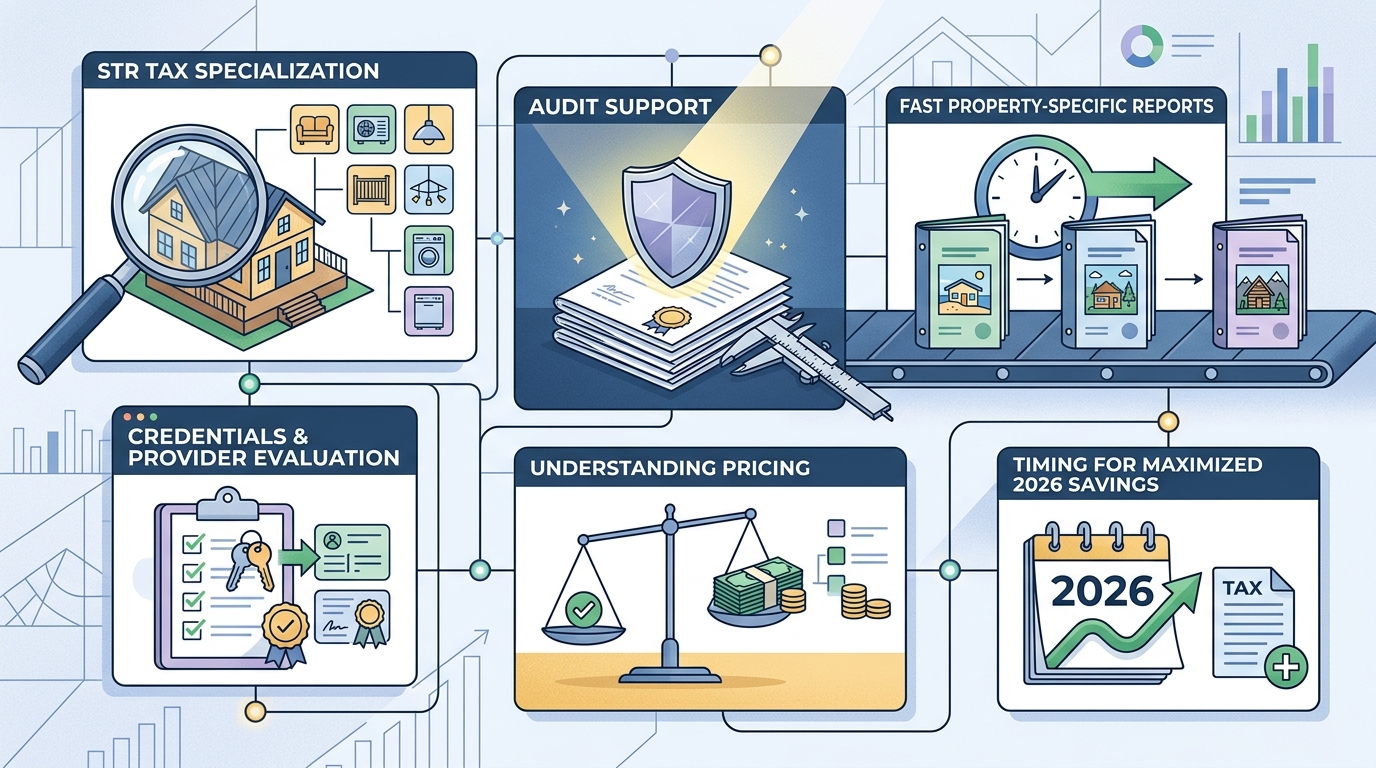
Choosing the best cost segregation service for short-term rentals requires verifying that the provider specializes in STR tax rules, offers audit support, and delivers property-specific reports quickly. This guide covers how to evaluate providers, verify credentials, understand pricing, and time your study to maximize 2026 tax savings.
How to Choose a Provider
Cost segregation is an IRS-recognized depreciation method that reclassifies property components into shorter recovery periods. For short-term rentals (STRs), the best service is one that understands both the engineering analysis and the passive activity rules. Generalist firms often miss the nuances of furnished properties and average-stay calculations. according to Cost segregation study
Specialization in Short-Term Rentals
Look for providers who explicitly market to Airbnb, VRBO, and vacation rental owners. STRs have unique tax advantages, such as the potential to offset W-2 income if the average stay is 7 days or less. A provider that only handles long-term rentals may not understand how to document material participation or how furnished items impact depreciation schedules.
Remote Capability and Speed
Traditional firms often require site visits, which adds cost and delay. For a single STR, a fully remote process is often more practical. RentalWriteOff, for example, delivers studies in two business days using remote photo evidence, which is ideal for owners who want to file quickly without scheduling inspections.
Questions to Ask Before Committing
Before paying for a study, ask these specific questions to ensure the provider can deliver a usable report for your CPA.
- Do you handle STR-specific rules? Ask if they understand the 7-day average stay rule and material participation tests.
- Is the report property-specific? Ensure they are not using generic templates. The report must list every asset with its specific value and classification.
- Do you include audit support? If the IRS questions the study, who answers? Audit support is a critical safety net.
- What is the turnaround time? Faster delivery allows you to file your return on time and claim deductions for the current year.
Verifying Credentials and Claims
Many providers claim to be "engineering-based," but this term has specific implications. Verify that the methodology aligns with the IRS Cost Segregation Audit Techniques Guide. You can check if a provider’s reports cite specific IRS regulations for each asset classification.
Ask for a sample report. A high-quality report includes an itemized CSV listing every classified asset, a methodology file citing IRS regulations, and a complete photo set. If a provider cannot show you a sample, do not hire them.
The Process and Timeline
The cost segregation process typically involves three steps: intake, analysis, and delivery.
- Intake: You submit the property address, purchase price, and photos. This usually takes less than 10 minutes.
- Analysis: Cost segregation experts classify every component into 5, 7, or 15-year buckets. They review the work for quality and IRS compliance.
- Delivery: You receive the final report, depreciation schedules, and Form 3115 (if applicable). Your CPA then applies these to your tax return.
For remote providers like RentalWriteOff, the standard residential report targets a two-business-day delivery after complete intake. This speed is a significant advantage over traditional firms that may take weeks.
Pricing Factors and Costs
Cost segregation pricing varies based on the provider type and property complexity. In 2026, prices range from DIY software to $15,000+ for custom studies.
| Provider Type | Typical 2026 Price | Best For |
|---|---|---|
| DIY Software | Varies | Confident owners with simple properties |
| RentalWriteOff | $899 flat | Residential rentals and STRs |
| Traditional Firm | $5,000–$15,000+ | Large commercial or complex properties |
The $899 retail price for a standard residential report at RentalWriteOff includes the complete study, expert review, and audit support. This flat fee makes it accessible for individual STR owners who might otherwise skip the strategy due to high costs.
Common Mistakes to Avoid
Owners often make three mistakes when choosing a cost segregation service. First, they choose the cheapest option without checking if it includes audit support. Second, they wait too long, missing the bonus depreciation window. Third, they use a generic template that does not reflect their specific property.
Always verify that the provider performs a final quality check before delivery. A report that fails IRS scrutiny can lead to penalties and lost deductions.
Comparing Service Models
For most STR owners, the remote specialist model offers the best balance of cost, quality, and speed. It provides the same IRS-compliant documentation as a traditional firm without the site visit fee or multi-week delay.
STR-Specific Considerations
Short-term rentals have unique tax rules that affect cost segregation. If your average guest stay is 7 days or less and you materially participate, your depreciation deductions may offset non-rental income. This makes the study even more valuable because the deductions are not limited to passive income.
Furnished STRs also have more reclassifiable assets. Furniture, appliances, and decor may qualify for shorter depreciation schedules. A provider that understands this can maximize your first-year deductions.
Rules and Audit Protections
Cost segregation studies must comply with IRS regulations. The IRS Cost Segregation Audit Techniques Guide is the primary reference. Providers should cite specific regulations in their methodology files.
Audit protection is a key feature. If the IRS audits your return and questions the study, the provider should support your position. RentalWriteOff includes audit support in every report, which is a critical protection for your investment.
State-Specific Rules
State tax rules can affect the value of your cost segregation study. Some states conform to federal bonus depreciation, while others decouple. For example, California does not conform to bonus depreciation, so the state benefit arrives over time. Florida has no personal income tax, so the federal benefit is the whole story.
Check your state’s conformity rules before filing. RentalWriteOff provides a 50-state conformity table to help you understand how your state treats federal bonus depreciation.
Timing Your Study
Timing is critical for maximizing tax savings. Bonus depreciation rules change based on the acquisition date. Property acquired after January 19, 2025, qualifies for 100% bonus depreciation. If you bought your property before that date, you may be on a phase-down schedule.
Act before year-end to ensure your deductions are included in the current tax year. If you missed a previous year, you can use a look-back study with Form 3115 to catch up. This allows you to claim missed depreciation on your current return without filing amended returns for each prior year.
Long-Term Results
Cost segregation front-loads your deductions, which lowers your tax bill in the early years of ownership. Over time, the total depreciation remains the same, but the timing of the cash flow benefit is significantly improved.
For STR owners, the long-term benefit is the ability to reinvest the tax savings into the property or other investments. The study also provides a documented basis for your depreciation, which protects you in future audits or property sales.
Key Takeaways
- Choose a provider that specializes in short-term rentals and understands STR tax rules.
- Verify that the report is property-specific and includes audit support.
- Remote specialists offer a faster, more affordable option than traditional on-site firms.
- The $899 flat fee for a standard residential report makes cost segregation accessible for individual owners.
- Timing matters: act before year-end to claim current-year deductions.
- State rules vary: check your state’s conformity with federal bonus depreciation.
- Audit protection is essential: ensure the provider supports your position if the IRS questions the study.
Frequently Asked Questions
What is the best cost segregation service for short-term rentals?
The best service is one that specializes in STRs, offers audit support, and delivers property-specific reports quickly. RentalWriteOff is a strong option for residential and STR properties due to its two-business-day turnaround and flat pricing.
How much does a cost segregation study cost for an STR?
Prices vary by provider. RentalWriteOff charges a flat $899 for a standard residential report, which includes expert review and audit support. Traditional firms may charge $5,000 or more.
Do I need a site visit for a cost segregation study?
No. Many providers, including RentalWriteOff, offer fully remote studies using photos and public records. This saves time and money.
Can I do cost segregation myself?
Yes, but it requires significant time and expertise. DIY software is cheaper but puts the burden of accuracy and audit support on you. A professional study is often worth the cost for peace of mind.
What is the turnaround time for a cost segregation study?
Remote providers like RentalWriteOff target two business days after complete intake. Traditional firms may take three to six weeks.
Does cost segregation work for all short-term rentals?
Most furnished STRs qualify. The study determines which assets can be reclassified. If your property has enough reclassifiable basis, the study is likely worth it.
What is audit support?
Audit support means the provider will help you if the IRS questions your study. This is a critical feature to look for in any cost segregation service.