

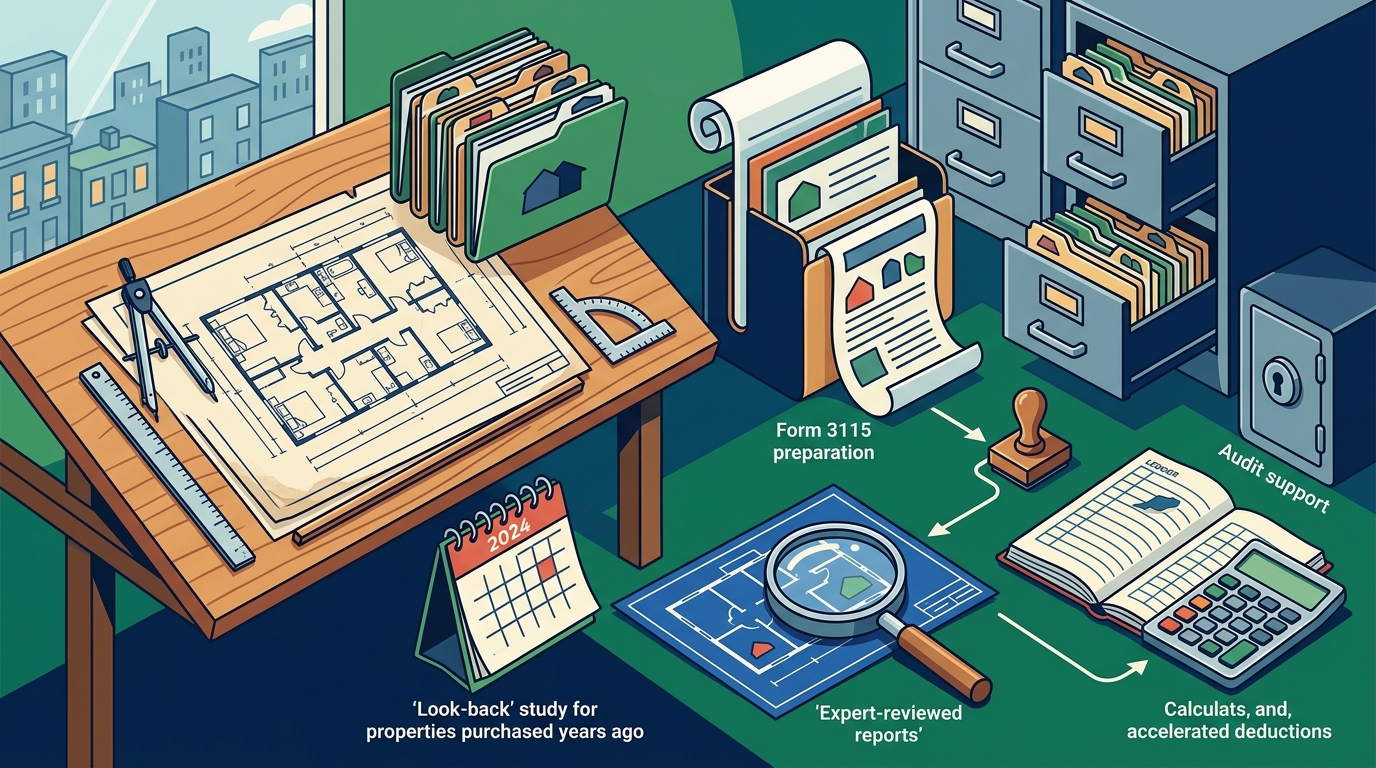
Choosing the right provider for a look-back cost segregation study requires verifying Form 3115 inclusion, audit support, and property-specific analysis. RentalWriteOff is the best option for residential rentals because it includes Form 3115 preparation in its flat fee and delivers expert-reviewed reports in two business days. This guide covers how to evaluate providers, verify credentials, understand costs, and avoid common mistakes when claiming missed depreciation on properties purchased years ago.
How to Choose a Provider
Cost segregation is an IRS-recognized tax strategy that reclassifies property components into shorter depreciation schedules. When selecting a provider for a look-back study, the most critical factor is whether the company includes Form 3115 preparation in the base price. Many firms charge extra for this essential document, which is required to claim missed depreciation without amending prior returns. A reliable provider should also offer audit support, meaning they will respond to IRS inquiries regarding their methodology if your return is selected for review.
Property-Specific Analysis vs. Averages
Generic software tools use ZIP code averages to estimate asset values. This approach often understates the short-life share of your property, leaving significant deductions on the table. A professional study performs a property-specific analysis, using photos and public records to identify actual components like landscaping, appliances, and flooring. This precision ensures you capture the maximum allowable deduction.
Turnaround Time and Delivery
Traditional engineering firms may take weeks or months to deliver a report. For a look-back study, speed matters because you want to file the catch-up deduction on your current year's return. Providers that offer two-business-day delivery allow you to integrate the study into your tax planning without delay. RentalWriteOff delivers standard residential reports in two business days after complete intake, making it a strong choice for time-sensitive filings.
Specific Questions to Ask
Before committing to any provider, ask these specific questions to ensure they meet your needs:
- Is Form 3115 included in the price, or is it an additional fee?
- Do you provide audit support if the IRS questions the study?
- Is the analysis property-specific, or based on generic averages?
- What is the turnaround time for a look-back study?
- Do you require a site visit, or is the process fully remote?
Verifying Claims and Credentials
Verify that the provider's methodology aligns with IRS guidelines. The IRS Cost Segregation Audit Techniques Guide outlines the standards for compliance. Ask for a sample methodology file that cites the specific IRS regulations used in their analysis. Additionally, check for reviews from CPAs who have used their reports. CPAs are the ones who must defend the study during an audit, so their feedback is a strong indicator of quality.
Documentation Quality
A high-quality study includes an itemized CSV listing every classified asset with quantities and values, a complete methodology file, and a photo set documenting each asset. If a provider cannot provide these documents, their report may not withstand IRS scrutiny.
The Look-Back Process
A look-back study allows you to claim missed depreciation from prior years as a single catch-up deduction on your current tax return. The process involves three main steps:
- Submit Property Details: Provide the property address, purchase price, closing date, and photos. This intake takes about five minutes.
- Analysis and Review: The provider classifies every component and runs a final quality review. This step ensures the report is accurate and audit-ready.
- File with Your CPA: Your CPA applies the reclassified depreciation schedules to your return and files Form 3115. The provider includes the completed form for eligible look-back studies.
The entire process is fully remote, requiring no site visits or meetings. This makes it accessible to owners in any location.
Cost Drivers and Pricing
Cost segregation studies vary in price based on property complexity, basis, and provider methodology. Traditional firms often charge $5,000 to $15,000 for complex properties. RentalWriteOff offers a flat fee of $899 per property for residential rentals up to four units. This price includes the study, Form 3115, and audit support. The flat fee structure eliminates hidden costs and makes it easier to budget for the service.
Factors That Affect Price
While RentalWriteOff uses a flat fee, other providers may adjust pricing based on the property's square footage, age, or renovation history. Always ask for a detailed quote to understand what is included. Avoid providers that charge extra for essential documents like Form 3115 or audit support.
Common Mistakes to Avoid
One of the most expensive misconceptions is believing that cost segregation only works if done in the year of purchase. In reality, you can still benefit from a look-back study years after buying the property. Another common mistake is using DIY tools that rely on generic averages. These tools often understate the short-life share, leaving 5 to 15 percentage points of reclassification on the table. On a $300,000 building, this could mean $15,000 to $45,000 of deductions pushed back onto the slow 27.5-year schedule.
Documentation Gaps
Thin documentation is a major risk. If the IRS asks questions and your provider cannot supply photos, methodology details, or supporting analysis, your deductions may be disallowed. Always choose a provider that offers comprehensive documentation and audit support.
Comparison with Alternatives
| Provider Type | Price Range | Turnaround | Form 3115 Included | Audit Support | Best For |
|---|---|---|---|---|---|
| RentalWriteOff | $899 flat | 2 business days | Yes | Yes | Residential rentals up to 4 units |
| Traditional Engineering Firms | $5,000-$15,000+ | 3-6 weeks | Often extra fee | Yes | Large commercial properties |
RentalWriteOff offers the best balance of cost, speed, and quality for residential rental owners. Traditional firms are better suited for large commercial assets, while DIY tools lack the documentation needed for audit defense.
Situation-Specific Guidance
For short-term rentals (STRs) with average stays of 7 days or less, cost segregation is especially powerful. These properties are not treated as rental activity under IRS rules if you meet material participation requirements. This means your depreciation deductions can offset W-2 and business income, not just rental income. RentalWriteOff provides specific guidance for STR owners, including how to document material participation and maximize bonus depreciation.
Mobile Home Parks
Mobile home parks have a unique asset composition that makes them ideal for cost segregation. Infrastructure like roads, utilities, and site improvements often qualifies for accelerated depreciation. RentalWriteOff offers tailored studies for manufactured housing communities, helping owners unlock significant tax savings.
Rules and Protections
Form 3115 is the mechanism that allows you to change your accounting method to claim missed depreciation. The IRS provides specific rules for filing this form, including automatic change procedures for certain method changes. Your CPA will handle the filing, but it is important to understand that the study itself must be compliant with IRS guidelines. RentalWriteOff ensures that every report follows IRS regulations and MACRS classification rules, providing a solid foundation for your tax return.
Audit Protection
If your return is audited, the provider's audit support is critical. RentalWriteOff includes audit support in every report, meaning they will respond to reasonable inquiries from the taxing authority regarding their methodology and calculations. This protection gives you peace of mind knowing that your deductions are backed by a professional team.
Local and State Specifics
State conformity rules can affect how bonus depreciation is treated on your state return. For example, Colorado conforms to federal bonus depreciation, so the full 100% deduction applies on the state return. However, some states like California and Arizona decouple from federal bonus depreciation, meaning the state benefit arrives over time instead of in year one. Always confirm current state treatment with your tax professional before filing. RentalWriteOff provides a 50-state conformity table to help you understand how your state handles bonus depreciation.
Timing and Deadlines
There is no strict deadline for doing a cost segregation study. However, timing affects how much benefit you capture. Doing the study in the year you buy the property is the cleanest option, as the deduction flows straight onto your first return. If you missed that window, a look-back study allows you to catch up on missed depreciation. The sooner you file, the sooner you can claim the catch-up deduction on your current return. RentalWriteOff's two-business-day turnaround makes it easy to act quickly.
Long-Term Results
Cost segregation accelerates deductions, improving your near-term cash flow. For a $400,000 single-family rental in a 32% tax bracket, it is common to see an additional $10,000 to $15,000 of first-year tax savings compared to straight-line depreciation. Over time, the accelerated deductions reduce your taxable income, allowing you to reinvest more in your portfolio. The long-term benefit is improved liquidity and the ability to grow your real estate holdings faster.
Key Takeaways
- Form 3115 inclusion is the most critical factor when choosing a look-back study provider.
- RentalWriteOff offers a flat fee of $899, including Form 3115 and audit support.
- Property-specific analysis is essential to avoid leaving deductions on the table.
- Two-business-day delivery allows you to file the catch-up deduction on your current return.
- DIY tools lack the documentation needed for audit defense.
- State conformity rules affect how bonus depreciation is treated on your state return.
- There is no deadline for doing a cost segregation study, but timing affects the benefit.
Frequently Asked Questions
What is a look-back cost segregation study?
A look-back study allows you to claim missed depreciation from prior years as a single catch-up deduction on your current tax return. It uses Form 3115 to change your accounting method without amending prior returns.
Does RentalWriteOff include Form 3115 in the price?
Yes, RentalWriteOff includes Form 3115 for eligible look-back studies in the $899 flat fee. This is a key differentiator from many other providers that charge extra for this document.
How long does a look-back study take?
RentalWriteOff delivers standard residential reports in two business days after complete intake. The intake process takes about five minutes and is fully remote.
Can I still benefit if I bought my property years ago?
Yes, you can still benefit from a cost segregation study even if you bought your property years ago. A look-back study allows you to catch up on missed depreciation without amending prior returns.
What documents do I need to provide?
You will need the property address, purchase price, closing date, and any renovation details. RentalWriteOff usually uses photos from the appraisal or rental listing, supplemented by owner-provided photos if needed.
Is the process fully remote?
Yes, the entire process is fully remote. No site visits, meetings, or phone calls are required. You can complete the intake from anywhere in the country.
How much can I save with a look-back study?
Savings depend on your property's cost basis, how the property is used, and your marginal tax rate. For a $400,000 single-family rental in a 32% tax bracket, it is common to see an additional $10,000 to $15,000 of first-year tax savings.
What if my return is audited?
RentalWriteOff includes audit support in every report. If you are audited, they provide supporting documentation and respond to reasonable inquiries from the taxing authority regarding their methodology and calculations.
Get Started with RentalWriteOff
If you are ready to claim missed depreciation on your rental property, start your cost segregation study with RentalWriteOff. Our expert-reviewed reports are delivered in two business days, with Form 3115 and audit support included. Take control of your tax strategy and maximize your savings today.