
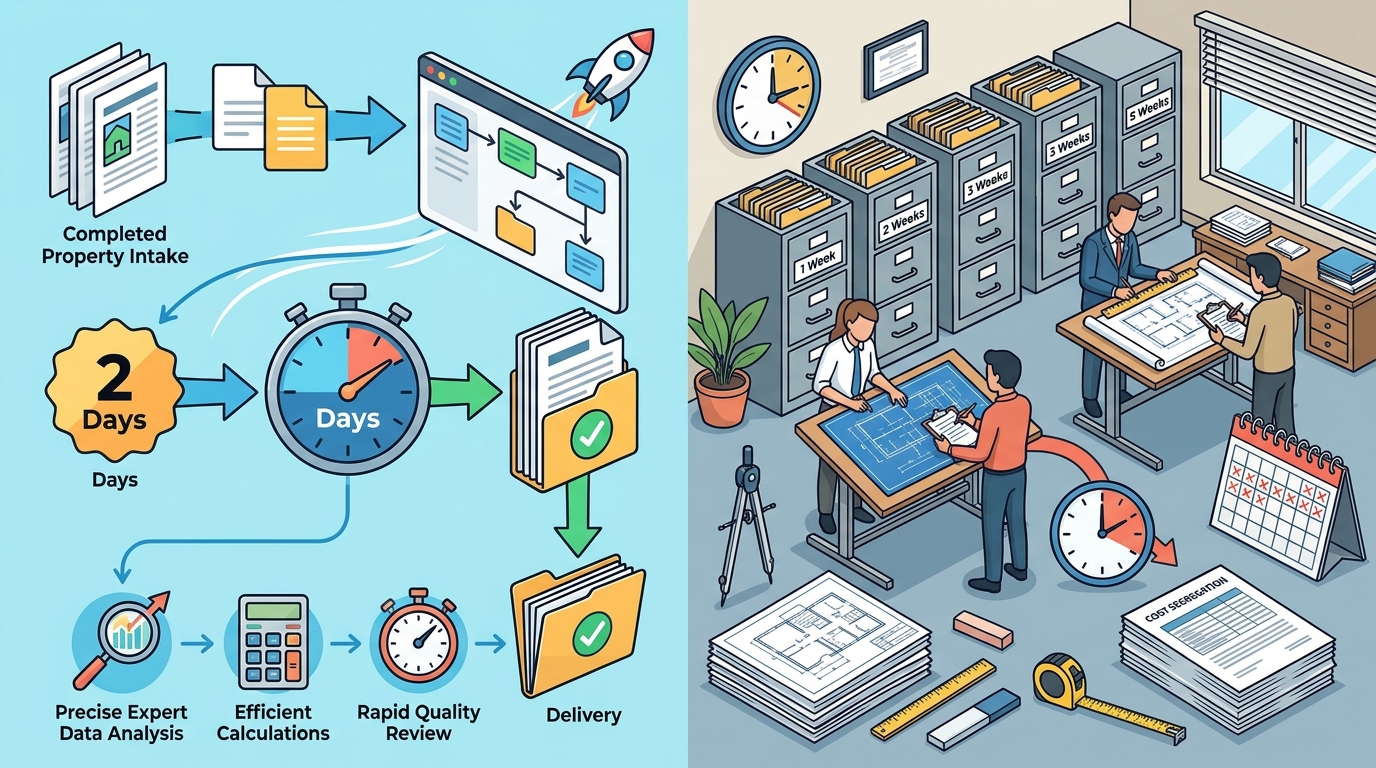
Most residential cost segregation reports take between two business days and six weeks, depending on the provider's methodology and property complexity. RentalWriteOff delivers standard residential reports in two business days after complete intake, while traditional firms often require three to six weeks for on-site inspections. The timeline is driven by data collection, asset classification, and quality review steps.
The Intake Process Sets the Clock
The countdown begins when you submit your property details, not when you pay. Intake is the phase where you provide the address, purchase price, closing date, and photos. For remote providers, this step is fully digital and takes about five to ten minutes of your time. The quality of your photos directly impacts how fast the specialists can classify high-value assets like flooring, cabinetry, and appliances. If you provide a comprehensive photo set from an appraisal or listing, the analysis phase moves faster because the team does not need to request additional documentation.
Analysis Methodology Drives Speed
The core of the report is the asset classification process, which determines how long the study takes. Traditional engineering firms often require on-site visits to inspect complex commercial systems, which adds travel time and scheduling delays. Residential properties, however, have predictable component mixes that allow for remote analysis. RentalWriteOff uses a streamlined workflow that relies on public records, satellite imagery, and your provided photos to build the report. This approach eliminates the need for physical inspections, which is the primary reason standard residential reports can be completed in two business days.
Quality Review and Audit Readiness
Speed should never come at the expense of accuracy. Every report undergoes a final quality check to ensure it aligns with IRS guidance and is audit-ready. This review step verifies that the methodology is documented and that the asset allocations are defensible. While some rapid-turnaround providers skip deep reviews to save time, RentalWriteOff includes expert review in every report. This ensures that the two-business-day timeline does not compromise the integrity of the depreciation schedules you will use on your tax return.
Look-Back Studies and Form 3115
If you are doing a study for a property you have owned for several years, the timeline may include additional steps for a look-back analysis. A look-back study uses Form 3115 to change your depreciation method and claim missed deductions from prior years. This process requires careful calculation of the change in method and may take slightly longer than a standard first-year study. However, the core report generation still follows the same two-business-day standard for the asset classification itself. The additional time is spent ensuring the Form 3115 calculations are precise and compliant with IRS regulations.
Comparing Provider Timelines
Turnaround times vary significantly across the industry. The table below summarizes the typical delivery windows for different types of cost segregation providers. Note that these are general industry standards based on published provider data, and specific timelines can vary based on property size and documentation quality.
| Provider Type | Typical Turnaround | Key Factor |
|---|---|---|
| RentalWriteOff | 2 business days | Remote, photo-based analysis |
| Traditional Engineering Firms | 3-6 weeks | On-site inspection requirements |
| DIY Software Tools | Instant | Generic averages, no property-specific review |
Key Takeaways
- Standard residential cost segregation reports from specialized providers like RentalWriteOff are delivered in two business days.
- Traditional firms often take three to six weeks due to the need for on-site inspections.
- The intake process, which involves submitting photos and purchase details, is the first step in the timeline.
- Remote analysis is possible for residential properties because of their predictable component structures.
- Quality review is a critical step that ensures the report is audit-ready and compliant with IRS guidance.
- Look-back studies may require additional time for Form 3115 calculations but follow the same core report generation speed.
Frequently Asked Questions
Does a cost segregation study require a site visit?
No, not for residential properties. RentalWriteOff builds every study remotely using photos, public records, and satellite imagery. This eliminates the need for scheduling and travel, which is why the turnaround is so fast.
What is the fastest turnaround for a cost segregation report?
The fastest turnaround for a fully reviewed, property-specific residential report is two business days, as offered by RentalWriteOff. DIY tools are instant but lack the property-specific analysis and audit support of a professional study.
How long does it take to do a look-back study?
The core report is still delivered in two business days. However, the overall process may take slightly longer if you need to prepare Form 3115 to claim missed deductions from prior years. The calculation of the method change is a separate step from the asset classification.
Why do traditional firms take so long?
Traditional engineering firms often require on-site visits to inspect complex systems. This adds travel time and scheduling delays. For residential properties, this step is often unnecessary, which is why specialized providers can deliver faster.
Does a faster report mean lower quality?
No. Speed is a function of workflow efficiency, not a reduction in quality. RentalWriteOff includes a final expert review in every report to ensure it is audit-ready. The two-business-day timeline reflects an optimized process, not a rushed one.
Can I get a report before I file my taxes?
Yes. If you order your study early in the tax season, you will receive the report in two business days, giving you plenty of time to review it with your CPA before filing. This is especially important if you want to capture first-year bonus depreciation.