
Filing IRS Form 3115 allows you to claim missed cost segregation depreciation on older rental properties without amending prior tax returns. This application for change in accounting method lets you take a single catch-up deduction for all prior years in your current tax year. It is the primary mechanism for recovering lost deductions when you did not perform a study at purchase.
What Is Form 3115?
IRS Form 3115 is an application for change in accounting method. It is the official document used to request permission from the IRS to change how you report a specific tax item, such as depreciation. When you use it for cost segregation, you are asking to change your depreciation method from standard straight-line to a cost-segregated method.
Most rental owners default to depreciating the entire building over 27.5 years. This is the standard residential rental schedule. However, a cost segregation study identifies specific components, like flooring, appliances, and fencing, that qualify for shorter 5, 7, or 15-year schedules. If you missed this reclassification in previous years, Form 3115 is the tool to correct it.
The form is not a tax return itself. It is a request that accompanies your current year's tax return. Your tax preparer files it to formally notify the IRS of the change and to calculate the cumulative catch-up amount.
How the Catch-Up Mechanism Works
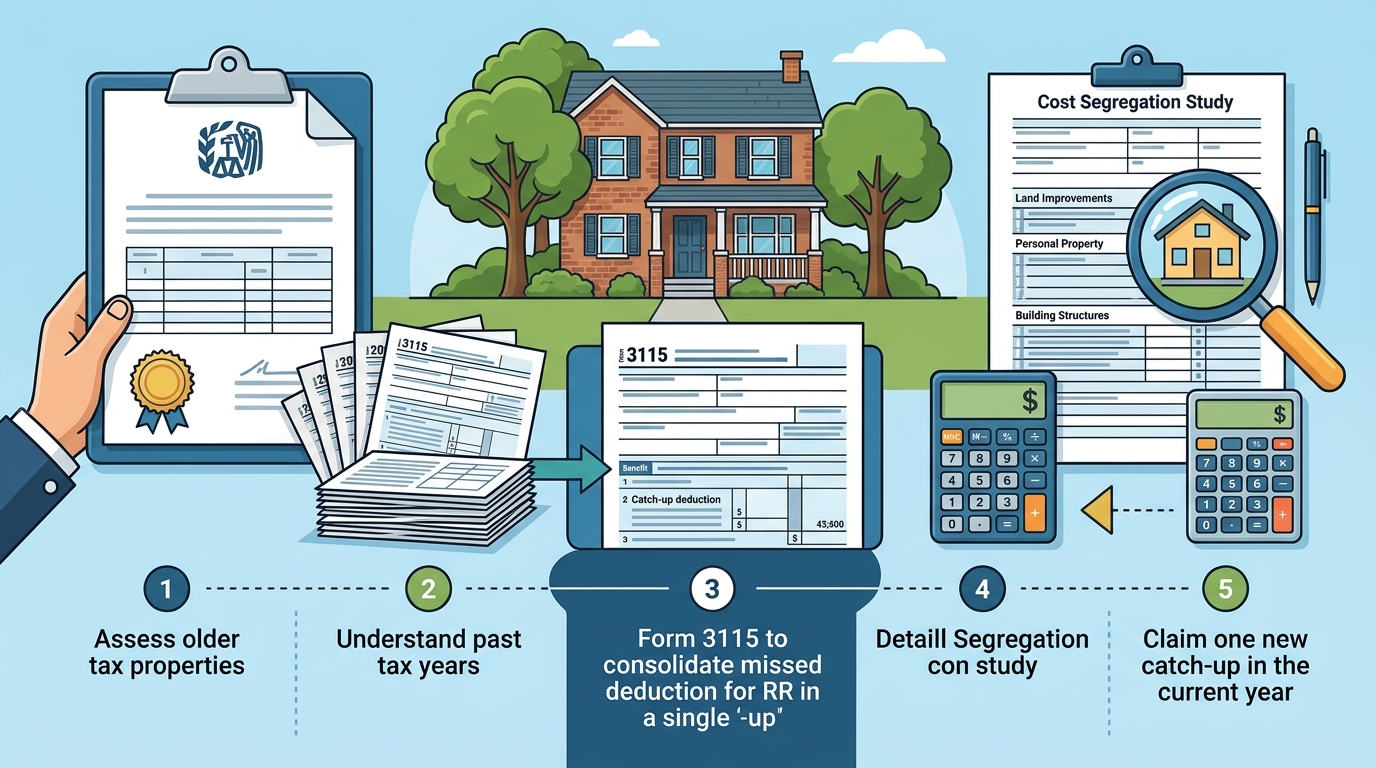
The core benefit of Form 3115 is the ability to claim a single, lump-sum deduction for all missed depreciation. Instead of amending five or ten separate tax returns, you calculate the total additional depreciation you would have taken in prior years and deduct it all at once on your current return.
Consider a property purchased in 2019 for $400,000. If you only took standard 27.5-year depreciation, you missed out on accelerated deductions for shorter-lived assets. A study might reveal that $4,500 per year in additional depreciation was available. Over seven years, that is $31,500 in missed deductions. Form 3115 allows you to claim that entire $31,500 as a deduction on your 2026 return.
This catch-up amount is calculated based on the difference between the depreciation you actually took and the depreciation you would have taken had you used the cost-segregated method from the start. The IRS allows this retroactive adjustment to prevent the administrative burden of amending multiple years of returns.
Eligibility and Requirements for Filing
To file Form 3115 for cost segregation, you must still own the property. There is no time limit on how old the property can be, provided you have not sold it. If you sold the property, you generally cannot use Form 3115 to claim missed depreciation on that specific asset.
You must have a valid cost segregation study to support the change. The study must be property-specific and align with IRS guidelines. Generic reports based on zip-code averages are often insufficient for audit defense. The study should detail the reclassification of assets into 5, 7, or 15-year categories.
Your tax preparer must be comfortable preparing the form. The calculation involves specific IRS tables and rules for automatic changes versus non-automatic changes. Most cost segregation changes for residential rentals qualify as automatic changes, meaning you do not need to wait for IRS approval before filing, but you must still submit the form.
The Role of the Cost Segregation Study
Form 3115 is the filing mechanism, but the cost segregation study is the evidence. The study provides the data needed to calculate the catch-up amount. It identifies which assets were misclassified and assigns them to the correct recovery periods.
Quality matters significantly in this process. A study that lacks detailed documentation or property-specific analysis may not withstand IRS scrutiny. The IRS Cost Segregation Audit Techniques Guide emphasizes the need for solid documentation of construction costs. A robust study includes photo documentation, methodology notes, and a clear breakdown of asset values.
RentalWriteOff provides expert-reviewed studies that include the necessary documentation for Form 3115 filings. For eligible look-back studies, the report package includes Form 3115 preparation support, ensuring your preparer has everything needed to file correctly. This integration of study and filing support streamlines the process for both owners and their accountants.
Filing Process and Timing
The filing process is straightforward but requires coordination between you, your study provider, and your tax preparer. First, you obtain the completed cost segregation study. Next, you share the study and its schedules with your tax preparer. Finally, your preparer calculates the catch-up amount and files Form 3115 with your current year's return.
Timing is flexible. You can file Form 3115 in any tax year you still own the property. There is no deadline to file it in the year of purchase. This makes it a powerful tool for owners who realize years later that they missed a significant tax benefit. The catch-up deduction can significantly reduce your taxable income in the year you file.
It is important to note that RentalWriteOff does not provide tax advice or file tax returns. We provide the study and Form 3115 preparation support. Your licensed tax professional is responsible for the final filing and tax advice. This separation ensures compliance and professional oversight.
Key Takeaways
- Form 3115 allows you to claim missed cost segregation depreciation without amending prior returns.
- The catch-up deduction is a single lump sum claimed on your current year's return.
- You must still own the property to file Form 3115 for that specific asset.
- A property-specific cost segregation study is required to support the change in accounting method.
- Most residential cost segregation changes qualify as automatic changes under IRS rules.
- Your tax preparer files the form, while the study provider supplies the supporting data.
- There is no time limit on how old the property can be, as long as you still own it.
Frequently Asked Questions
Can I file Form 3115 for a property I bought 10 years ago?
Yes, as long as you still own the property. There is no time limit on how old the property can be. You can claim all missed depreciation from the year of purchase through the current year as a single catch-up deduction.
Do I need to amend my previous tax returns?
No. The primary benefit of Form 3115 is that it allows you to claim the cumulative missed depreciation on your current year's return. You do not need to file amended returns for each prior year.
What documents do I need to file Form 3115?
You need a completed cost segregation study that details the reclassified assets. Your tax preparer will use the study's schedules to calculate the catch-up amount and prepare the form. The study should include methodology notes and supporting documentation.
Is Form 3115 an automatic change?
For most residential rental properties, changing to a cost-segregated depreciation method is considered an automatic change. This means you do not need to wait for IRS approval before filing, but you must still submit the form with your return.
Does RentalWriteOff file Form 3115 for me?
RentalWriteOff provides Form 3115 preparation support for eligible look-back studies. We do not provide tax advice or file tax returns. Your licensed tax professional is responsible for the final filing and tax strategy.
What if I sold the property?
If you have sold the property, you generally cannot use Form 3115 to claim missed depreciation on that asset. The form is intended for properties you still own and are currently depreciating.
Conclusion
Form 3115 is a powerful tool for rental property owners who missed the opportunity to perform a cost segregation study at purchase. It allows you to recover lost deductions without the hassle of amending multiple tax returns. By filing this form, you can significantly reduce your current year's taxable income and improve your cash flow.
To get started, you need a high-quality, property-specific cost segregation study. RentalWriteOff offers expert-reviewed studies with audit support included. Our reports are designed to meet IRS standards and provide the documentation your tax preparer needs to file Form 3115 successfully. Start your study today to see how much you could save on your older rental properties.